An industrial control panel enclosure is the shell around the nervous system of a machine or production line — the PLCs, drives, contactors, terminal blocks and HMIs that keep automation running. It has to do three jobs that actively fight each other: keep people away from live parts, keep the environment away from the electronics, and let a technician wire and service the panel for years. Most panel problems are not component failures — they are geometry decisions made before anyone ordered metal: a cutout too close to a bend, a vent with no path for heat to leave, a painted seam where a bond was assumed. This guide works through the decisions in the order they bite, with the numbers behind each.
Key takeaways
- Sealing, cooling and serviceability pull against each other. A panel that is easy to seal is hard to cool, and one that is easy to wire is hard to seal. Decide which one governs before the layout is drawn.
- IP and NEMA are not interchangeable. Every NEMA type meets or exceeds a corresponding IP code, but the reverse is not true — NEMA 250 adds corrosion, icing and oil requirements that IEC 60529 does not test.
- Heat load decides the thermal strategy, in bands. Roughly: below 30 W a sealed panel can conduct; 30–150 W needs vented natural convection; 150–500 W needs forced air; above 500 W needs zoning or liquid.
- Cutout location is the biggest source of rework. A 22 mm push-button hole is standard; the same hole too close to a bend line cracks on the brake. Standardise a ±0.1 mm band and dimension cutout-to-bend clearance.
- SanJun is a sheet metal fabricator. We build the enclosure, the machining and the evidence. We do not issue assembly listings or certificates of compliance, and we do not run UL 9540A — the completed-assembly certificate belongs to the panel builder and their NRTL or notified body.
What does a control panel enclosure actually have to do?
Three jobs, and they compete for the same square millimetres:
- Protect people. Keep fingers and tools away from live parts, carry fault current to earth through a deliberate path, and stay shut while energised. This is why door hardware, hinges and locks are specification items rather than catalogue afterthoughts — see our hinge and latch hardware guide.
- Protect the electronics. Keep dust, water, oil and cleaning chemicals out, keep the interior below the derating temperature of the drives, and stop condensation forming on a cold night.
- Stay serviceable. Let a technician land a cable, swap a contactor and re-terminate a rail without re-drilling the panel.
The conflicts are real and should be settled on paper. A fully gasketed, unvented box is excellent at the second job and terrible at the third and, above about 30 W of internal dissipation, terrible at the second as well. A wide-open louvred box is excellent at cooling and fails the moment someone hoses it down. Naming which job governs — per installation, not per product line — is the cheapest decision in the project.
What lives inside the panel, and what does each component demand?
A typical industrial panel carries a programmable logic controller (PLC), variable-frequency drives (VFDs), contactors and relays, terminal blocks, circuit breakers or fuses, a power supply, and a human-machine interface (HMI). Each one asks the sheet metal for something different:
- VFDs and power supplies dissipate heat continuously and derate above their stated ambient. They set the thermal budget.
- Contactors, transformers and large breakers are heavy and vibrate. They set subplate thickness and stiffening requirements.
- Terminal blocks run on 35 mm DIN rail and set the rail layout, which in turn sets the panel depth.
- The HMI and push-buttons are cutouts in the door, and cutouts are where dimensional errors become visible. An HMI window that is half a millimetre out does not seat; see our HMI enclosure design guide.
- Busbars and power terminals need electrical spacing, which is a metal-geometry problem rather than a wiring one.
Listing the components with their heat, weight and cutout requirements before layout starts turns a drawing into something that can be quoted accurately. The RFQ checklist uses exactly that list.
Which IP or NEMA rating does the site actually require?
Two standards describe ingress, and they are not the same system. IEC 60529 defines the IP two-digit code — solids first, liquids second, and nothing else. NEMA 250 defines North American Type ratings, which bundle ingress with corrosion resistance, ice formation and oil exposure. Every NEMA type meets or exceeds a corresponding IP code, but the conversion runs one way only: NEMA's own standard states IP ratings cannot be directly converted to NEMA types.
| NEMA type | Approximate IP equivalent | What it adds beyond IP | Typical control-panel use |
|---|---|---|---|
| NEMA 1 | IP10 | Baseline indoor protection | Dry, clean indoor utility rooms |
| NEMA 3R | IP14 | Outdoor rain and ice (no dust rating) | Sheltered outdoor equipment |
| NEMA 4 | IP66 | Hose-directed water, dust, ice | Washdown areas, outdoor plant |
| NEMA 4X | IP66 | NEMA 4 plus corrosion resistance | Food, chemical, marine, coastal |
| NEMA 6P | IP68 | Prolonged submersion | Pits, flood-prone locations |
| NEMA 12 | IP52 | Indoor dust and dripping liquids | Standard factory floor |
| NEMA 13 | IP54 | Dust, sprayed water and oil | Machine tool and coolant areas |
The rating that costs people money is NEMA 4X. Its dust and water performance is equivalent to IP66, but 4X additionally mandates corrosion-resistant material or finish — typically 304 or 316 stainless, or suitably coated aluminium. IP66 says nothing about corrosion, so a painted carbon-steel enclosure can legitimately be labelled IP66 and still rust through a season on a marine dock. If your specification says NEMA 4X and a supplier offers "IP66 equivalent", that is not the same answer.
The tests also differ in severity: the NEMA 4 hose test uses a 25.4 mm nozzle at 65 gallons per minute for at least five minutes, roughly 2.5 times the water volume of the IP66 jet test. Our NEMA versus IP ratings guide covers the full comparison, and the gasket sealing guide covers how the rating is actually achieved at the joint. Cable entries are the other half of the same problem — each entry is either a gland or a conduit run, compared in our conduit versus cable gland guide.
How do you keep a control panel from overheating?
Heat leaves an enclosure through four mechanisms, and every thermal decision trades one against another: conduction through the wall, natural convection through vents, forced convection with a fan, and radiation from the surface. Aluminium sheet conducts at roughly 160 W/m·K against about 50 W/m·K for cold-rolled steel — about five times better — but that advantage only matters if the heat has a path out. A sealed aluminium box traps heat as effectively as a sealed steel one. A fan multiplies convection by roughly 5–10×, at the cost of noise, dust ingress and another component that can fail. Radiation is a small contributor below 80 °C.
What determines the strategy is total internal dissipation:
| Internal heat load | Strategy | What the sheet metal has to provide |
|---|---|---|
| Up to ~30 W | Conduction through the wall to ambient | Sealed box; 2.0 mm or thicker aluminium, or external heat-sink fins. No vents, no fans. |
| ~30–150 W | Conduction plus natural convection | Filtered IP54 vents low and high so a chimney effect works — cool air in low, hot air out high. |
| ~150–500 W | Forced convection | Fan or blower cutouts, filtered intake and exhaust, and a plan for fan-fail derating. |
| 500 W and above | Forced convection plus heat pipe or liquid, or thermal zoning | Separate hot zones (drives) from cool zones (PLC, HMI), and design the wall as part of the heat path. |
Two geometry rules prevent most thermal callbacks. Keep the lower edge of any vent at least 5 mm above the enclosure floor, because standing water inside the box is a failure regardless of how well the vent is rated. And on a panel standing in direct sun, keeping solar load off the roof does more than any vent — see our outdoor sunshade design guide. Vent geometry that preserves the rating is covered in the perforated vent pattern guide and the vent pattern cost and CFM guide; the whole discipline is in the thermal management guide. Where a sealed panel swings between hot days and cold nights, condensation rather than heat becomes the failure — see the condensation control guide.
How should the mounting system and cutouts be laid out?
Standardisation is what makes a panel buildable by others. The 35 mm mounting rail — TS35, EN 60715 — is the common rail inside a sheet metal control enclosure, in three profile depths: 7.5 mm (TS35/7.5), 15 mm (TS35/15) and the asymmetric 35 × 7.5 profile (TS35/AS) used for terminal blocks. All share the same 35 mm outer width; depth is chosen by how much weight the rail must carry. The 22 mm push-button cutout is standardised as IEC 61554 / DIN 43700.
Where panels go wrong is rarely the standard dimension — it is location and tolerance:
- Standardise the tolerance band. Cutout dimensions are nominal, and the standard band is wide enough that sloppy fabrication produces a connector that will not seat. Document a tighter band — typically ±0.1 mm — on the drawing.
- Keep cutouts clear of bend lines and welds. A hole too close to a bend cracks when the panel is brake-formed; this is the single biggest source of rework on a control enclosure.
- Dimension the subplate. A removable mounting plate lets the panel be wired on a bench, faster and safer than wiring in situ — see the subplate and mounting plate guide.
- Make the gland plate removable. A bolt-in bottom plate means cable entries can be changed without re-cutting the enclosure.
Our DIN rail and panel cutout guide sets out the rail sizing, cutout patterns and knockout geometry, with the nine DFM rules that close it. For cables once they are inside, see the internal cable management guide.
What does grounding and bonding require from the metal?
"Ground" is three different functions and each needs its own conductor: protective earth carries fault current when line voltage touches the enclosure; functional ground is the signal reference for low-level analogue circuits; and equipotential bonding ties the metal parts together so no two surfaces sit at different potentials. Treating them as one conductor is the most common drawing error here.
The sheet metal implication is blunt: coating is an insulator. A painted, gasketed bolted seam can measure in the megohm range across the joint, so a bolted seam is not a bond. Where a bonding path is required, the contact area must be masked before coating or machined bare afterwards, and the drawing has to show where. Dedicated terminations — a weld stud, a PEM clinch nut or a riveted ground lug — are cheap on the panel and expensive to add after commissioning. Our grounding and bonding guide covers the three classes, the termination methods and the failure modes.
Continuity matters for a second reason. A panel with continuous welded seams performs better as an EMC shield than one assembled from loosely joined panels, relevant when VFDs sit in the same box as analogue I/O. See the EMI shielding guide.
How do clearance and creepage change the design?
Two distances decide whether a power-rated panel passes its dielectric test. Clearance is the shortest path through air, set by impulse voltage; creepage is the shortest path along a surface, set by working voltage, pollution degree and the material's CTI group. Both must be satisfied, and in a power enclosure the longest paths are rarely on a board — they run from a busbar to a painted wall, from a terminal block to a DIN rail, from a cable lug to a hinge.
Three points matter at the drawing stage. First, paint, powder coat and anodising do not count as insulation: measure the path as if the metal were bare, or add a rated barrier. Second, altitude correction starts at 2,000 m — a site at 4,000 m needs roughly 29% more clearance than the table value. Third, the governing number comes from the product standard that applies to your assembly, not from the base standard: IEC 60664-1 (current edition IEC 60664-1:2020 with Amendment 1 published in 2025) is a horizontal base standard applied by IEC 61439, IEC 62368-1, IEC 61010-1 and UL 508A.
Sheet metal has six cheap ways to buy spacing — standoff height, a slot, a formed rib, an insulating barrier, a sleeve, or re-segregating the layout. All six cost pennies at design stage and a re-tool later. Put the distance on the drawing as a dimensioned, toleranced feature; "verify creepage at assembly" is not a specification. Our clearance and creepage guide works through the tables and the six levers.
Which material and finish suit the environment?
Material is chosen by environment and weight, then confirmed against cost and finish:
| Material | Where it is the right choice | Finishing | Watch out for |
|---|---|---|---|
| Cold-rolled steel (SPCC) | Default for indoor panels — cost, stiffness and ease of coating. | Powder coating, any RAL colour | The coating is the entire corrosion barrier; cut edges and scratches are where it fails. |
| Stainless steel 304 / 316 | Washdown, food, pharmaceutical and coastal sites — the practical answer to a NEMA 4X requirement. | Passivation, or a brushed or bead-blasted finish | Weld heat tint and embedded iron defeat passivation; cleaning has to precede it. |
| Aluminium | Where weight matters — portable, wall-mounted or console panels — and where conduction cooling helps. | Anodizing or powder coating | Galvanic corrosion where it meets steel; anodizing hides no substrate defects. |
Finishing is usually electrostatic powder coating, which gives a tough, chip-resistant, UV-stable surface in any RAL colour. Specify it as a system — pretreatment, film thickness, colour, gloss and masked areas — rather than as a colour, and remember that a coating is an insulator wherever a bond is needed. Our surface finishing guide and corrosion resistance guide cover the choice; stainless versus carbon steel covers the material argument, and the galvanic corrosion guide covers dissimilar metals meeting in the assembly. For washdown specifically, the hygienic washdown design guide sets out the geometry rules.
Welded or modular construction?
Both are legitimate and suit different programmes. A welded enclosure is stiffer, gives continuous seams for EMC and sealing, and arrives as one piece — at the cost of shipping volume and any later geometry change. A modular or knock-down enclosure ships flat, assembles on site and tolerates modification, but every extra seam is another joint to seal and another bond to make. The answer usually follows volume and logistics: welded for a repeatable product, modular where freight or field assembly dominates. Our welded versus modular construction guide sets out the trade-off, and the welding guide covers process choice and distortion control. For floor-standing units, lifting and mounting provisions are part of the same decision — see the lifting eye and mounting bracket guide.
What does certification require, and who signs it?
The first thing to understand is that there are two certificates, not one, and they are evaluated separately:
- The empty enclosure. North America uses UL 50 for construction and UL 50E for environmental considerations. Europe and the UK use IEC 62208 (EN 62208) for empty enclosures up to 1,000 V AC and 1,500 V DC. Both cover ingress, material and joint strength, closure behaviour, corrosion resistance and protective-circuit continuity.
- The completed assembly. North America evaluates an industrial control panel under UL 508A, with NEC Article 409 covering installation and NFPA 79 covering machine-mounted panels. IEC-land verifies designs to IEC 61439-1, -2 and -3.
Three cautions follow. NEMA certifies nothing — NEMA 250 defines Type ratings; it is not a certification body. Machining voids more certificates than design does: an empty-enclosure certificate survives only while the enclosure stays unmodified, so an HMI window cut into a certified door can invalidate the evidence for the box — order cutouts upstream. And Type/IP, SCCR and temperature rise are three different numbers; a rating is one input to a qualification programme, not a substitute for one.
Our side of the boundary is specific. SanJun supplies the metal, the machining and the supporting evidence, and builds to the agreed procedure. We are a sheet metal fabricator: we do not issue assembly listings or certificates of compliance, and we do not run UL 9540A. The completed-assembly listing belongs to the panel builder and their NRTL or notified body. Where a project needs a witnessed third-party test or a certificate naming a specific standard, that is agreed at RFQ and run by the named laboratory. The full map is in our enclosure certification guide, and how to write a plan worth running is in the qualification test plan guide.
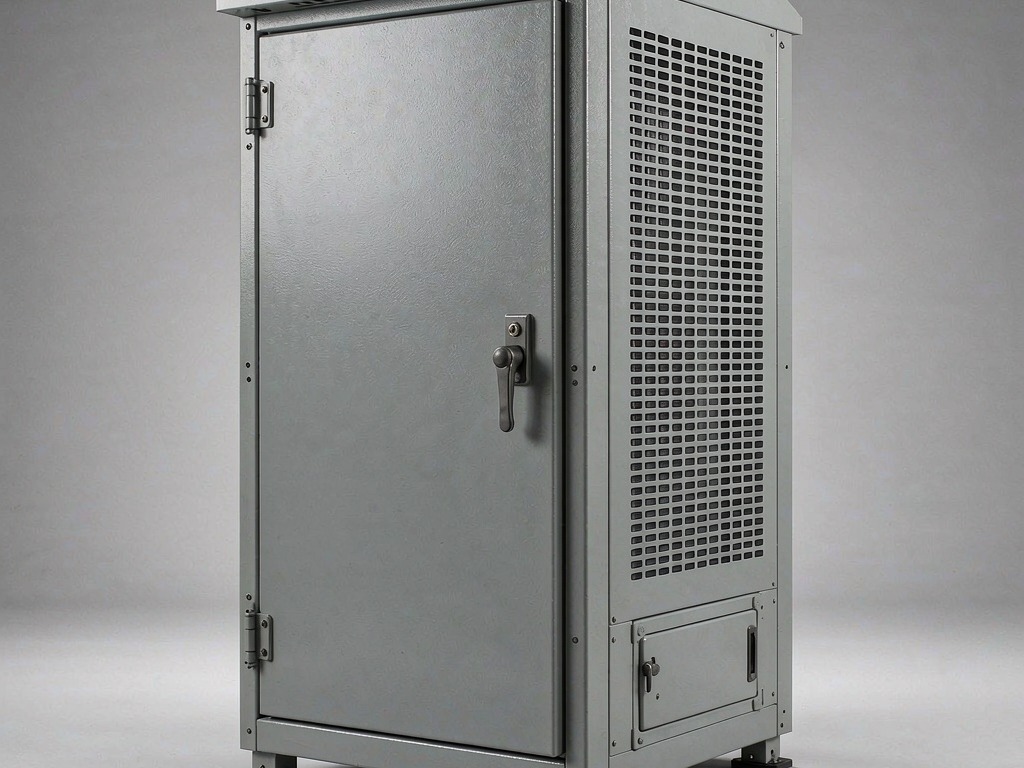
Two things should be settled before the panel ships: which entries are tooled at the factory, and what happens when one more cable appears on site. The second is worked through in the field modification and IP sealing guide.
Frequently Asked Questions
What is the difference between a control panel enclosure and an electrical cabinet?
A control panel enclosure is usually a wall-mounted or console-mounted housing for controls and instrumentation, while an electrical cabinet is a larger floor-standing unit that also carries power distribution, busbars and heavier switchgear. Both are fabricated from sheet metal and follow the same IP, thermal and grounding rules — the difference is scale.
What IP or NEMA rating should an industrial control enclosure have?
Indoor factory panels commonly use IP54 or NEMA 12; washdown, dusty or outdoor sites need IP65/IP66 or NEMA 4/4X. Choose by site condition, not habit: NEMA 4X is not equivalent to IP66, which carries no corrosion requirement. SanJun fabricates from IP20 to IP66 with gaskets, glands, louvers and rain hoods.
How do you keep a control panel from overheating?
Start from the total internal dissipation. Up to about 30 W a sealed panel can conduct heat through the wall; 30–150 W needs filtered vents low and high so natural convection works; 150–500 W needs a fan with filtered intake and exhaust plus a fan-fail derating plan; above 500 W, zone the panel or move to liquid cooling. Keep any vent's lower edge at least 5 mm above the floor.
Which material should I use — steel, stainless or aluminium?
Cold-rolled steel is the default for indoor panels on cost and stiffness, powder coated in any RAL colour. Stainless 304 or 316 is the answer for washdown, food, pharmaceutical and coastal sites and for a genuine NEMA 4X requirement. Aluminium suits portable or wall-mounted panels where weight matters, and helps conduct heat out of a sealed box.
Can you cut the HMI window and push-button holes, and does that affect certification?
We machine the cutouts, and you should have us do it rather than drilling later. An empty-enclosure certificate covers the enclosure as tested, so field machining — an HMI window cut into a certified door, or a swapped gland plate — can void the evidence for the box. Order cutouts upstream, state which certificate must survive, standardise a ±0.1 mm band and keep holes clear of bend lines.
Do you provide grounding studs and bonding provisions?
Yes, and they should be on the drawing. Coating is an insulator, so a bolted painted seam is not a bond — you need a weld stud, a PEM clinch nut or a riveted ground lug, with the contact area masked before coating. Specify protective earth, functional ground and equipotential bonding as three separate provisions.
Can SanJun certify the completed control panel?
No. We build the enclosure, do the machining and supply supporting evidence to the agreed procedure — but we do not issue assembly listings or certificates of compliance, and we do not run UL 9540A. The completed-assembly certificate under UL 508A or IEC 61439 belongs to the panel builder and their NRTL or notified body; the empty-enclosure scope under UL 50/50E or IEC 62208 is separate.
What do I need to provide for a control enclosure quote?
Send 2D or 3D drawings or a sketch, overall dimensions, the component layout with heat load, the required IP or NEMA rating, the thermal strategy, material and finish, any certification scope, and estimated quantity. We return a DFM review and quotation within 24 hours, and flag cutout locations, vent placement and bonding provisions before metal is cut.
Start your control enclosure project
Whether you need a single prototype control panel or a production run of floor-standing cabinets, send us the drawings or requirements. Our engineers provide free CAD and DFM review to optimise cost, thermal performance and manufacturability, and flag cutout locations, vent placement and bonding provisions that cause trouble later. Minimum order quantity is one piece, standard parts ship in 7–15 working days and complex custom builds in 20–30 days. See our industrial control enclosure manufacturing page. For the full sequence see our nine-step fabrication process, schedule drivers the enclosure lead time guide, and for cost structure the custom enclosure cost guide.
Need a reliable industrial control enclosure? Send your drawings today and get a quotation within 24 hours.
On a panel enclosure the seams sit on the faces people see, so weld appearance acceptance criteria belong in the drawing package rather than in a conversation at goods-in.
A control panel carries certification, clearance and marking requirements alongside its layout; those are collected in the compliance and quality cluster.