Key takeaways
- Hygienic washdown enclosure design is a geometry problem before it is a material problem. Water that cannot leave and a crevice that cannot be reached will fail on 316L exactly as they fail on painted steel.
- IP69K is a test, not a material. Per ISO 20653 the jet is 80–100 bar at 80 °C, 14–16 L/min, from 0.10–0.15 m, at four angles for 30 s each. Build to those numbers and the rating follows.
- 304L is fine for a dairy office wall and wrong for a brine room. Use the chloride load, not the price list: 304L to roughly 200 ppm, 316L to roughly 1,000 ppm, duplex 2205 or 254 SMO above that.
- Surface roughness is the number audits actually measure. Ra ≤ 0.8 µm (32 µin) for washdown zones, Ra ≤ 0.4 µm (16 µin) where product can contact or where CIP validation is tight.
- The gasket fails more often than the steel. Match the elastomer to the CIP chemistry — silicone for steam and caustic, EPDM for caustic but not fats, FKM for acids and solvents, PTFE-jacketed for the worst of both.
- Compression points decide whether a jet lifts the seal. No corner more than 200 mm from a latch, no more than 250 mm between latches, and a 25% compression target on the cord.
A poultry processor in the Midwest replaced 22 control enclosures in one washdown line over eighteen months. Every one of them was stainless. Every one of them was "IP66". Every one of them failed the same way: a flat roof that held a puddle of foam, a stitch-welded seam that wicked caustic into the corner, and a gasket that swelled until the jet at 90° lifted it off the door. The steel was never the problem. Hygienic washdown enclosure design is decided long before anyone picks a grade — it is decided by whether water can leave, whether a brush can reach, and whether the elastomer survives the cleaning chemistry that the process demands.
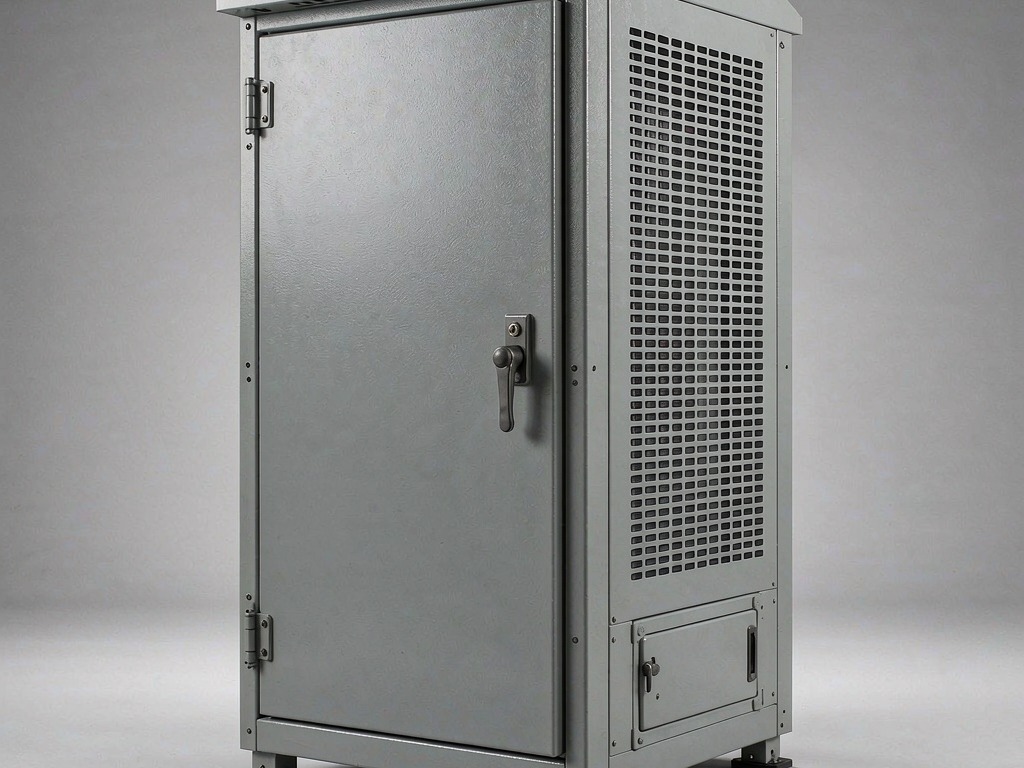
This guide is the washdown package we now quote with every food, beverage, dairy and pharmaceutical enclosure. It covers what the ingress codes actually test, how to choose between 304L, 316L and duplex on chloride load rather than habit, the surface roughness numbers an auditor will ask for, eight geometry rules that make an enclosure cleanable, how welds and fasteners become contamination traps, which elastomer survives your CIP cycle, what the build levels really cost, and a five-step specification you can paste straight into an RFQ. For the sealing detail itself, pair it with our gasket sealing to IP65 guide.
Why a Standard Enclosure Fails in a Washdown Zone
A general-purpose industrial enclosure is designed to keep water out. A hygienic enclosure has to do that and let water leave, and survive being hit with 80 °C caustic every night for twenty years, and present a surface a brush can actually clean. Those are four different requirements and most catalogue products are built for the first one.
The failure pattern is remarkably consistent in our service log. Water sits on the roof because the roof is flat. It finds the door joint because the gasket has relaxed. It carries cleaning chemical into a crevice at a stitch weld or under a screw head. It pools behind a bracket that is welded flat to the back panel. Then the line starts up, the box warms, the trapped moisture evaporates and leaves behind whatever was dissolved in it — salt, caustic, product residue — and the corrosion starts from the inside of the joint outward.
There is a second, quieter mechanism that catches people out. Cold-room and chilled-process enclosures see the same physics described in our enclosure condensation control guide: a hot wash followed by a cold room means the internal surfaces drop below the dew point of the air trapped inside. A hygienic enclosure that drains perfectly can still manufacture its own water, so the washdown specification and the condensation strategy have to be written at the same time.
The regulatory pressure is not abstract. In the EU, food-contact and food-area equipment sits under Framework Regulation (EC) No 1935/2004 and the hygiene GMP of (EC) No 2023/2006, with machinery hygiene requirements in EN 1672-2. In the US, FDA 21 CFR Part 117 ties the equipment to the preventive controls the plant must document, and 21 CFR 177.2600 governs the rubber articles that touch food. None of those documents say "buy an IP69K box". All of them say the equipment must be cleanable to a demonstrated standard — which is a design outcome, not a purchase outcome.
Reading the Ratings: IP66, IP69, IP69K and NEMA 4X
The codes are tests, and the differences between them are the whole point. IP69K comes from ISO 20653 (road vehicles) and its predecessor DIN 40050-9; the equivalent code inside IEC 60529 is IPX9. The test parameters are effectively the same, which is why the two terms get used interchangeably and why a supplier quoting one should be able to show a report for the other.
| Code | Standard | Jet / nozzle | Pressure | Water temp | Duration & distance | What it proves |
|---|---|---|---|---|---|---|
| IP65 | IEC 60529 | 6.3 mm nozzle | 30 kPa at 3 m | Ambient | 1 min/m², min 3 min | Low-pressure jet from any direction |
| IP66 | IEC 60529 | 12.5 mm nozzle | 100 kPa at 3 m | Ambient | 1 min/m², min 3 min | Powerful jet — a hose-down, not a washdown |
| IP69 / IPX9 | IEC 60529 | 4 spray angles (0°, 30°, 60°, 90°) | 8–10 MPa (80–100 bar) | 80 ± 5 °C | 30 s per angle, 0.10–0.15 m | High-pressure, high-temperature washdown |
| IP69K | ISO 20653 / DIN 40050-9 | 4 spray angles, 14–16 L/min | 8–10 MPa (80–100 bar) | 80 ± 5 °C | 30 s per angle, 0.10–0.15 m | Same severity, road-vehicle naming |
| NEMA 4X | NEMA 250 | Hose-directed water | Not defined as a pressure | Ambient | Hose test per UL 50E | Watertight plus corrosion resistant |
Two things follow. First, IP66 is not a washdown rating — it is a powerful-jet rating at ambient temperature, roughly one-thousandth of the pressure of IP69K and without the thermal shock. Second, NEMA 4X says nothing about high-pressure hot washdown; its value is the corrosion requirement, which is why North American specifications often ask for "NEMA 4X, IP69K" as a pair. Our NEMA vs IP rating comparison sets out where the two systems stop overlapping.
Also note what the test does not cover. Ingress testing is performed on an empty enclosure, at ambient, before any chemical exposure, and it does not check cleanability, surface roughness or gasket chemistry. A box can pass IP69K on day one and be a hygiene problem by month six if the gasket was chosen for price.
Material Selection: 304L, 316L and Duplex
Pick the grade from the chloride load at the wash temperature, then check it against the cleaning chemicals. The low-carbon "L" grades matter here because welding is how these enclosures are built: 304L and 316L keep carbon at or below 0.03%, which prevents chromium carbide precipitation in the heat-affected zone and the sensitisation that produces the classic weld-line rusting.
| Grade | PREN (approx.) | Chloride tolerance at ambient | Typical washdown use | Material premium vs 304L | Watch out for |
|---|---|---|---|---|---|
| 304L | 18–20 | Up to ~200 ppm | Dry processing, packaging halls, bakeries, brewhouse control rooms | Baseline | Brine, seafood, cheese, any hot chloride |
| 316L | 24–26 | Up to ~1,000 ppm | Meat and poultry, dairy, ready meals, most pharma | +35–60% | Hypochlorite at high concentration and temperature |
| 2205 duplex | 34–36 | Several thousand ppm | Seafood, brine rooms, desalination skids, coastal docks | +90–140% | Formability; needs a slower bend radius and competent welding |
| 254 SMO / AL-6XN | 42–44 | High chloride plus oxidising chemistry | Aggressive CIP, bleach-heavy sanitation | +180–280% | Availability and lead time |
PREN is the pitting resistance equivalent number, %Cr + 3.3 × %Mo + 16 × %N. It is a ranking tool, not a design limit — temperature moves the real threshold downward fast, and a 60 °C caustic wash with 400 ppm chloride is a harsher environment for 304L than the column above suggests. Where the enclosure sits in a flour, sugar or spice area, the material decision also has to be read against the dust atmosphere: see our hazardous location enclosure guide for Zone 21/22 combinations.
One more rule from the log: the grade has to be consistent all the way through, including the wall brackets, the standoffs, the gland plate and the fasteners. A 316L cabinet on zinc-plated brackets will grow rust streaks under the cabinet within a year, and the customer photographs the streak, not the cabinet.
Surface Finish, Passivation and Electropolishing
Roughness is the number an auditor can measure, so it is the number that ends up in the specification. Ra is the arithmetic average roughness; 0.8 µm equals roughly 32 µin.
| Finish | Ra (µm) | Ra (µin) | How it is produced | Cleanability | Premium on the shell |
|---|---|---|---|---|---|
| Mill / 2B as received | 0.8–2.0 | 32–79 | None | Poor — rolling marks hold soil | Baseline |
| Brushed / No. 4, 180–240 grit | 0.4–0.8 | 16–32 | Mechanical linishing, unidirectional | Good for splash zones | +6–12% |
| Fine brushed, 320–400 grit | 0.3–0.5 | 12–20 | Multi-stage mechanical polish | Good for washdown zones | +12–20% |
| Electropolished | 0.2–0.4 | 8–16 | Electrochemical dissolution | Best — no directional valleys, reduced bacterial adhesion | +25–45% |
| Bead blasted (glass bead) | 1.0–1.6 | 40–63 | Blasting | Poor — peaks and valleys, traps soil | +5–10% |
Two details decide whether the finish performs. Direction: brush marks should run in the direction water drains, so a vertical door carries vertical grain. Passivation: every welded stainless enclosure should be passivated after fabrication to remove free iron picked up from tooling — to ASTM A967 (nitric or citric methods) or ASTM A380 — and the certificate should travel with the parts. Passivation is not a coating and adds no thickness; it removes the iron particles that would otherwise rust and stain the surface. Our stainless steel surface finish guide covers the mill finishes in more detail.
Electropolishing is worth its premium in two situations: where a CIP validation has to demonstrate cleanability quantitatively, and where the line runs a product that forms a biofilm quickly (dairy, protein, ready meals). It removes a few microns of surface, rounds the micro-peaks, and raises the chromium-to-iron ratio at the very top of the surface.
The Eight Hygienic Geometry Rules
- Slope every nominally horizontal surface. A minimum of 3° for drainage, but we build washdown roofs at 30° because it also sheds foam, stops operators putting things on top, and makes the roof visually inspectable from the floor.
- No ledges, no pockets, no upward-facing flat. Any bracket, handle or nameplate plate that creates a horizontal shelf becomes a soil trap. Stand the cabinet off the wall on hygienic standoffs with a rounded profile and a sealed contact patch.
- Internal corners radiused to at least 3 mm, ideally 6 mm. A sharp internal corner cannot be cleaned to a validated standard, full stop. This is the single most common drawing defect we send back.
- Continuous welds on the outside. Stitch and spot welds leave a crevice every pitch. Where a seam is outside the product zone it still has to be continuous and sealed on the process side.
- No exposed threads in the product or splash zone. Use hygienic studs with acorn nuts, captive flange nuts, or through-bolts with domed heads and a sealed washer. A screw head in a washdown area is a reservoir.
- Drainage with a defined path. Sloped gland plate, a true low point, and either a hygienic drain or a weep path that cannot wick. A "sealed" box with no drain becomes a bath the first time the seal is breached.
- Doors that open far enough to clean. 120° minimum swing, lift-off or quick-release hinges, and no fixed internal obstruction across the opening.
- Minimum 50 mm wall clearance, 150 mm where a hose has to reach behind. Hygiene rules are defeated by installation: a perfectly sloped cabinet bolted flat against a tiled wall creates the puddle the roof was designed to avoid.
Welds, Joints and Fasteners
Welding method sets the crevice count. TIG (GTAW) gives the cleanest, most controllable seam on thin stainless and is our default for hygienic work; laser welding gives a narrow, low-distortion seam that needs little dressing and suits long straight runs; MIG is acceptable on heavier sections but throws more spatter and needs more post-work. Whatever the process, outside corners are dressed and polished back to the parent finish, and the weld map goes into the documentation pack. Our sheet metal welding guide covers the process selection in depth.
The rules that matter for hygiene specifically:
- Weld from the process side wherever possible; a seam welded from outside leaves a crevice opening into the product zone.
- Dress the weld flush and re-passivate the whole assembly, not just the seam.
- Avoid lap joints that open toward the product flow. A lap joint is only acceptable if it is continuously welded on the upstream edge and the free edge points away from product.
- Use hygienic standoffs, not flat spacers — a flat spacer creates two crevices and a moisture bridge to the wall.
- Match the fastener metallurgy to the shell and isolate anything unavoidably dissimilar.
Gaskets and Cable Entries Under Pressure Wash
The elastomer is chosen by chemistry first and temperature second. Every option below is available in an FDA 21 CFR 177.2600 compliant grade, and that compliance applies to the compound, not to the profile — ask for the certificate against the part number.
| Elastomer | Continuous temp range | Caustic (NaOH 1–5%) | Acid (HNO₃ 1–2%) | Steam / SIP | Fats and oils | Relative cost |
|---|---|---|---|---|---|---|
| Silicone (FDA) | −60 to +200 °C | Good | Good | Excellent | Fair | 1.0× |
| EPDM | −40 to +130 °C | Excellent | Good | Excellent | Poor — swells | 0.8× |
| FKM (Viton) | −20 to +200 °C | Poor — attacked by hot caustic | Excellent | Poor | Excellent | 2.5–3.5× |
| Nitrile (NBR) | −30 to +100 °C | Fair | Fair | Poor | Excellent | 0.7× |
| PTFE-jacketed foam core | −70 to +260 °C | Excellent | Excellent | Excellent | Excellent | 3–5× |
The choice that surprises people is EPDM: it is the best-value caustic gasket on paper and the wrong choice on a meat or ready-meal line, because fats swell it, the cord extrudes out of the groove and the compression is gone. Fats plus caustic is exactly the case for silicone.
Compression is the other half. Design to roughly 25% compression on a solid cord, up to 40% on a hollow section, and place the latches so that no point on the seal is more than 200 mm from a compression point and no two points are more than 250 mm apart. On a 600 × 800 mm door that is six quarter-turn latches, not four. Hygienic hardware should be 316L, with a smooth domed head, no exposed thread and a shrouded hinge barrel — see the hinge and latch hardware guide for the load calculations.
Cable entry is where most washdown assemblies lose their rating. Use sloped gland plates, stainless or nickel-plated brass glands with the correct IP69K insert, seal unused knockouts with a blank of the same material, and never route a conduit into the top of a washdown cabinet without a drain hole at the lowest point of the run.
Cleaning Chemistry Compatibility
Ask the sanitarian for the CIP sheet before you specify anything. Then read this table as the cross-check.
| Cleaning agent | Typical concentration | Typical temperature | 304L | 316L | Silicone gasket | EPDM gasket | FKM gasket |
|---|---|---|---|---|---|---|---|
| Caustic soda (NaOH) | 1–5% | 60–80 °C | Good | Good | Good | Excellent | Poor |
| Nitric acid (HNO₃) | 0.5–2% | 50–60 °C | Good | Good | Good | Good | Excellent |
| Peracetic acid | 0.2–1% | 20–50 °C | Fair | Good | Fair | Good | Good |
| Sodium hypochlorite | 100–500 ppm | 20–50 °C | Poor | Fair | Fair | Fair | Good |
| Steam / SIP | — | 121–140 °C | Good | Good | Excellent | Excellent | Poor |
| Chlorinated alkaline foam | 2–4% | 20–60 °C | Poor | Fair | Fair | Good | Good |
Hypochlorite and chlorinated foam are the two entries that most often force a grade upgrade. Chloride-driven pitting does not need a high bulk concentration — it needs a crevice, a wet surface that dries, and time.
What It Costs and How Long It Takes
These bands come from our own quote log, for a 600 × 800 × 250 mm wall-mount control enclosure in a quantity of 25 units.
| Build level | Rating target | Typical premium vs a painted carbon steel IP66 box | Typical lead time |
|---|---|---|---|
| 304L brushed, continuous welds, standard hardware | IP66 | +55–85% | 15–20 days |
| 304L, 30° roof, hygienic hardware, FDA silicone gasket, sloped gland plate | IP66 / hygienic geometry | +80–120% | 20–25 days |
| 316L brushed Ra ≤ 0.8 µm, hygienic hardware, passivated | IP69K | +130–190% | 25–32 days |
| 316L electropolished Ra ≤ 0.4 µm, full documentation pack | IP69K + cleanability validated | +170–250% | 30–40 days |
| Duplex 2205 or 254 SMO, high-chloride duty | IP69K | +300–480% | 40–55 days |
Where the money actually goes is worth saying out loud: on the middle three rows, roughly 40% of the premium is material, 35% is welding and finishing labour, and 25% is hardware and documentation. The documentation pack — weld map, Ra report, passivation certificate, gasket material certificates, ingress test report — is the cheapest part of a hygienic build and the part that decides whether the enclosure passes commissioning.
The Five-Step Hygienic Enclosure Specification
- Define the wash regime. Pressure, temperature, chemistry, frequency and duration. "High-pressure hot wash, 2% caustic at 70 °C, twice daily, weekly chlorinated foam" is a specification. "Washdown" is not.
- Convert it into a rating and a grade. Hot and high-pressure means IP69K or NEMA 4X plus IP69K; chemistry and chloride load set 304L / 316L / duplex; the audit requirement sets the Ra number.
- Fix the geometry on the drawing. Roof slope, internal radii, standoffs, drain path, wall clearance, door swing. Draw the drain arrow on the general arrangement — if you cannot, the box will pool.
- Specify the seal and the hardware to the chemistry. Elastomer by CIP sheet, compression target, latch count and spacing, gland material and orientation.
- Write the verification and documentation requirements into the PO. Weld map, surface roughness report, passivation certificate to ASTM A967, gasket certificates, ingress test report to ISO 20653 or IEC 60529 IPX9, plus a first-article cleanability check. Everything in our quality control and inspection guide applies here, with the hygiene documents added.
Buyers building a full plant standard usually start from the panel-level guidance in our industrial control panel enclosure guide and add this washdown annex to it.
Eight Failure Modes From Our Service Log
- Flat roof. Standing water, standing foam, biofilm, and an auditor's photograph. Fixed by a 30° roof for 2–4% of the shell cost.
- Stitch-welded external seams. Every pitch is a crevice that fills with caustic and dries to salt. Fixed by continuous weld and dressing.
- Exposed screw heads on the door face. Product residue under the head, then rust. Fixed with captive domed hardware.
- EPDM gasket on a fatty line. Swelling, extrusion, loss of compression, water in the box by week three.
- Painted carbon steel brackets on a 316L cabinet. Rust streaks down the wall below. Fixed by matching the bracket material.
- No drain path. The gland plate is the low point; water sits in it and wicks along the cable.
- Too few latches. At the 90° jet angle, the mid-span of the door lifts a few tenths of a millimetre and the jet finds the gap.
- Sharp internal corners. R0 or R1 corners that cannot be cleaned to any validated standard — the most common reason we return a drawing.
Frequently Asked Questions
Is IP69K the same as IP69?
The severity is effectively identical. IP69K is the ISO 20653 / DIN 40050-9 designation that came out of road-vehicle practice; IPX9 is the IEC 60529 version. Both specify 80 ± 5 °C water at 8–10 MPa, 14–16 L/min, from 0.10–0.15 m, at four angles for 30 s each. Practically, a test report to either one is evidence for both, but ask to see the report rather than the logo.
Do I need 316L, or is 304L enough?
It depends on the chloride load at wash temperature, not on the industry label. 304L is fine in a dry bakery or a brewhouse control room. It is the wrong choice in a brine room, a seafood line, a cheese plant, or anywhere a chlorinated sanitiser is used weekly — those go to 316L, and the highest loads go to duplex. If you are unsure, send us the CIP sheet and the water analysis and we will put a grade recommendation in writing.
What surface roughness should I specify for a washdown area?
Ra ≤ 0.8 µm (32 µin) is the working number for a washdown splash zone, and Ra ≤ 0.4 µm (16 µin) where product can contact the surface or where a CIP validation has to be demonstrated quantitatively. Specify the Ra value and the method (mechanical polish or electropolish), because two finishes can measure the same Ra and clean very differently — electropolished surfaces have no directional valleys.
Can a painted carbon steel enclosure be used in a washdown area?
Not in the product or splash zone. Coating defects are inevitable over a service life measured in thousands of wash cycles, and a chip at a corner becomes a rust site that contaminates the area below. Carbon steel is acceptable in adjacent dry zones — motor control centres in a separate electrical room, for example — and that split is how most plants balance cost against compliance.
How many latches does an IP69K door need?
Enough that no point on the seal is more than about 200 mm from a compression point, and no two adjacent points are more than 250 mm apart, at roughly 25% compression on a solid cord. For a 600 × 800 mm door that is six quarter-turn latches. Four latches on that door is the most common cause of a corner leak at the 90° jet angle.
Chloride-bearing cleaning agents pit stainless by the same wet-dry mechanism that a continuous fog test never reproduces. The reasoning is set out in why continuous salt fog misses the chloride pitting mechanism.
Where to Go Next
Enclosures that survive a washdown also have to survive the trip to the plant and the cost review that follows it. Two companion pieces cover those: how we pack and crate enclosures for export so a 316L cabinet does not arrive with rust bloom, and how nesting and material yield change the unit price on a stainless programme.