Most enclosure corrosion problems we get asked to fix are not coating problems. They are specification problems. A supplier sends a certificate that says "passed 1,000 h salt spray," the cabinet ships to a coastal substation, and red staining appears along the door hem within eighteen months. The coating very likely did everything the test asked of it. The test simply never asked the right question. This guide covers sheet metal corrosion testing from the manufacturing side: what the standards actually define, how to write a duration that means something, how to read a rating, and the eight mistakes that turn a passing report into field scrap.
Key Takeaways: Sheet Metal Corrosion Testing
- ASTM B117 and ISO 9227 are method standards. Neither one sets a test duration or a pass/fail criterion — that comes from your product specification or drawing.
- ISO 9227 defines three methods (NSS, AASS, CASS), not four. Cyclic corrosion testing lives in separate standards: ASTM G85, SAE J2334, GMW 14872, ISO 11997-1, IEC 60068-2-52.
- "1,000 hours" is meaningless on its own. It only becomes a requirement when you attach a failure definition: no red rust, or red rust below a stated area, or a maximum scribe creep width.
- Salt spray hours are not service years. Use ISO 9223 corrosivity categories plus ISO 12944 durability bands as the shared language instead.
- A flat test coupon measures your coating system. A production-representative part measures your manufacturing system. First article should be the latter.
Why corrosion testing is a specification problem, not a lab errand
Nobody owns corrosion testing on a project. Purchasing wants a line for the PO. The structural engineer wants to know whether the sample in the chamber resembles the assembly that ships. Quality wants a report that survives an audit. Usually all three assume somebody else wrote it down.
In our experience reviewing first-article reports and incoming supplier certificates, the failure is almost never that a coating was badly applied. It is that the test request was so thin that almost any result could be called a pass. "Salt spray 1,000 h" written into a drawing with no specimen definition, no rating method and no failure threshold is not a requirement. It is a hope.
This guide is about the verification side of corrosion. If your question is "which coating system should I choose," start with our sheet metal coating selection guide instead. The dividing line is simple: if the verb in a paragraph is choose or compare coatings, it belongs there. If the verb is specify, run, rate or misjudge, it belongs here.
The three families of corrosion tests
Every accelerated corrosion test you are likely to see on an enclosure drawing falls into one of three families. Knowing which family a method belongs to is more useful than memorising its parameters, because the family tells you what the result can and cannot support.
Neutral salt spray (NSS) — the baseline
Continuous fog, constant temperature, constant chemistry. No drying stage, no UV, no mechanical damage. This is ASTM B117 and the NSS method of ISO 9227.
NSS is excellent at one thing: comparing like with like. Run two batches of the same part through the same chamber and the better one will usually win. That makes it a solid tool for supplier screening, batch-to-batch consistency checks and quick triage. It is a poor tool for predicting how long a cabinet will last outdoors, and the standards themselves warn against using it that way.
Acidified variants — AASS and CASS
Lower the pH with acetic acid and you get acidified salt spray (AASS). Add copper chloride and raise the temperature and you get the copper-accelerated acetic acid salt spray (CASS), covered by ASTM B368. These are harsher and produce visible results faster.
They exist mainly for decorative electroplated finishes — think copper-nickel-chromium stacks on trim and hardware. Using CASS to qualify an outdoor powder-coated steel enclosure is usually a category error: you are applying a decorative-plating screen to a barrier-protection system and then wondering why the numbers look alarming.
Cyclic corrosion testing (CCT)
Alternate a wet salt stage with high humidity and a drying stage, and repeat. That is cyclic corrosion testing. Representative methods include ASTM G85 (a family of modified salt spray procedures), SAE J2334 and GMW 14872 from the automotive world, ISO 11997-1 for paints and varnishes, IEC 60068-2-52 for environmental testing, and VDA 233-102 in the German automotive supply chain.
CCT costs more and takes longer per data point, but for coastal sites, de-icing salt exposure and long outdoor service it is the more honest test. The mechanism is explained in the section on why salt spray hours are not field years.
| Family | Typical methods | Best used for | Weak at |
|---|---|---|---|
| Neutral salt spray | ASTM B117, ISO 9227 NSS | Batch comparison, supplier screening, quick triage | Life prediction, real-world ranking |
| Acidified (AASS / CASS) | ISO 9227 AASS / CASS, ASTM B368 | Decorative plated finishes, fast screening | Outdoor barrier systems (frequent misuse) |
| Cyclic (CCT) | ASTM G85, SAE J2334, GMW 14872, ISO 11997-1, IEC 60068-2-52 | Coastal, de-icing salt, long outdoor service | Cheap screening; slower and costlier |
ASTM B117 vs ISO 9227: what actually differs
This is the question we get most often, and the answer is rarely what people want to hear: under neutral conditions the two standards are close enough that the choice seldom changes the outcome. What changes the outcome is the execution detail that nobody writes down.
Operating parameters side by side
Under neutral conditions the two are nearly identical: 5% NaCl, pH 6.5–7.2 measured at 25 °C, a 35 °C chamber, and a collection rate of 1.5 ± 0.5 mL per 80 cm² per hour. They differ mainly in specimen angle — 15–30° from vertical under ASTM B117 versus 15–25° under ISO 9227 — and in how the report documents execution.
| Parameter | ASTM B117 | ISO 9227 (NSS) |
|---|---|---|
| Solution | 5% NaCl by mass | 5% NaCl (commonly expressed as 50 ± 5 g/L) |
| pH of collected solution | 6.5–7.2, measured at 25 °C | 6.5–7.2, measured at 25 °C |
| Chamber temperature | 35 °C (a ±2 °C tolerance is commonly cited; confirm against the current edition) | 35 °C (confirm tolerance against the current edition) |
| Fog collection rate | 1.5 ± 0.5 mL per 80 cm² per hour (i.e. 1.0–2.0) | 1.5 ± 0.5 mL per 80 cm² per hour (i.e. 1.0–2.0) |
| Specimen angle | 15–30° from vertical | 15–25° from vertical, ideally near 20° |
Two cautions. First, chamber temperature tolerance and specimen angle differ between sources and between editions — some Chinese-language pages still quote 45° or 60°, which is wrong. Second, if you are quoting a standard on a drawing, quote the edition year too. "ASTM B117" with no year is a moving target.
ISO 9227 defines three methods, not four
ISO 9227 specifies three salt spray methods: NSS (neutral), AASS (acetic acid) and CASS (copper-accelerated acetic acid). It does not contain cyclic methods — a lot of published content gets this wrong. Cyclics are their own standards.
| ISO 9227 method | Solution | pH | Temperature |
|---|---|---|---|
| NSS | 5% NaCl | 6.5–7.2 | 35 °C |
| AASS | 5% NaCl plus acetic acid | 3.1–3.3 | 35 °C |
| CASS | 5% NaCl plus acetic acid plus copper chloride | 3.1–3.3 | 50 °C |
Commonly cited crosswalks are NSS with ASTM B117, AASS with the acidified procedure in ASTM G85, and CASS with ASTM B368. Annex numbering inside ASTM G85 is a recurring source of disagreement between sources, so put the method name rather than the annex number on your drawing.
If you see an old German drawing calling up DIN 50021, that standard was superseded by ISO 9227 — worth updating the reference rather than arguing about equivalence. In the Chinese supply chain you will also meet GB/T 10125 (aligned with ISO 9227) and GB/T 2423.18 (aligned with IEC 60068-2-52).
Which one belongs on your drawing
Pick by market and by data history, not by rigour:
- North American end customer with an existing NSS database → ASTM B117.
- EU customer, or a coating supplier quoting ISO 12944 durability → ISO 9227 NSS.
- Any coastal, de-icing salt or long-outdoor-service application → add a cyclic method alongside, not instead.
Then write down the angle, the cleaning method and the rating standard. Those three details move results far more than the choice between B117 and 9227. For a broader view of what finishes you are choosing between, see surface finishing options for sheet metal enclosures.
Sample preparation: what makes a report survive audit
A corrosion report is only as good as the object you put in the chamber. This is the section most specifications skip, and it is where audit failures originate.
Flat coupon vs real part
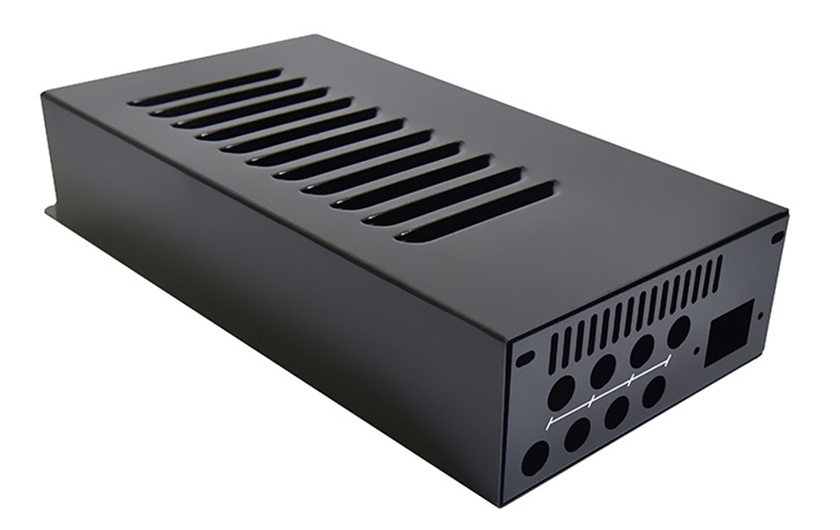
A flat panel answers: is this coating system sound? A production part answers: is this manufacturing system sound? Those are different questions. The features that corrode first on a real enclosure are almost never present on a flat coupon:
- laser-cut or sheared edges, where the coating thins and the substrate is exposed
- punched hole walls and the burr side of a pierced feature
- the outer radius of a bend, where the film is stretched
- welds and heat-affected zones, with oxide, discolouration and flux residue
- the ring around press-fit fasteners, where the coating is displaced
- hemmed seams and lap joints, which hold electrolyte by capillary action
Our recommendation: qualify with a production-representative part, or a sample panel that carries the real features. Use flat coupons for ongoing batch trend monitoring, where you want a stable reference rather than a pass/fail gate.
Two of the six features above are process outcomes rather than design features: how the weld and its heat-affected zone should be prepared, and how edge break and deburring change what the coating has to cover. Both are worth settling before you put anything in a chamber.
To scribe or not to scribe
A scribe is a deliberate scratch through the coating to the substrate. It is used to measure how far corrosion creeps sideways from the damage, evaluated per ASTM D1654.
Scribe when the question is adhesion and under-film propagation — comparing pretreatments, or checking whether a coating delaminates once breached. Do not scribe when the question is barrier integrity of an intact part; you have just created the failure you were testing against, and the result tells you little about an undamaged cabinet.
If you do scribe, specify the tool, the width, whether it crosses to bare metal, and the maximum creep distance. "Scribe creep ≤ 2 mm" with no scribe definition is not reproducible.
Placement, separation and post-test cleaning
- Set the angle within the standard's range and record it.
- Specimens must not touch each other, and condensate from one must not drip onto another.
- Do not put different base metals or different plating systems in the same chamber run — corrosion products cross-contaminate and you will chase a phantom.
- After exposure, rinse gently with clean water and dry with clean air. Do not wipe. Wiping removes corrosion product and loose coating and quietly improves your rating.
Interim inspection and documentation
If you need a 1,000-hour result, plan interim checks rather than one look at the end. Keep each check short so the chamber does not drift, and record what you saw.
A report that will survive an audit should contain: standard number and edition year; specimen description with a unique identifier; solution concentration, pH, chamber temperature, collection rate, angle, and total duration; pre- and post-test photographs; and the secondary rating standards used. Missing any of those and the report is decorative. For how this fits into a broader incoming and in-process routine, see our quality control and inspection workflow.
How many hours should you specify?
The standards deliberately don't tell you
This is the single most useful thing to understand. ASTM B117, ISO 9227 and JIS Z 2371 define how to run the fog. They do not define how long to run it, and they do not define what counts as failure. Duration and acceptance come from the product specification, the customer drawing, or an industry specification that cites the test method.
So "1,000 hours" is not a standard requirement. It is a convention that became a convention because someone's customer asked for it once.
Indicative hour bands by finish
The bands below reflect common industry practice across the sources we reviewed. They are not standard requirements, and any number you write into a PO should come from your product specification.
| Finish | Commonly specified band (indicative practice only) |
|---|---|
| Zinc plating, clear / blue passivate | 96–168 h to white rust |
| Zinc plating, yellow / iridescent passivate | 168–336 h |
| Hot-dip galvanising | Several hundred to over 1,000 h |
| Powder coating on steel with pretreatment | 500–1,000 h (some specifications go to 1,500 h) |
| E-coat (electrophoretic primer) | Several hundred to 1,500 h |
| Anodising, standard or hard | Several hundred hours |
| Duplex system (zinc plus paint) | 1,000–3,000 h |
| Marine / offshore high-performance system | 1,000 h and up |
None of these figures appears in ASTM B117 or ISO 9227. Any number you write into a PO should come from your product specification. The bands also assume the substrate question is already settled, so read them alongside which base metal the environment actually points to.
If you are choosing between paint systems, our powder coating vs liquid painting comparison covers what each achieves on a real part, and for aluminium housings see aluminum anodizing for outdoor enclosures.
Hours alone mean nothing without a failure definition
Four thresholds appear again and again, and they are not interchangeable:
- No red rust anywhere on significant surfaces. The strictest common form.
- Red rust below a stated area percentage, often 5%, rated against ASTM D610 or ISO 4628-3.
- Scribe creep below a stated width, commonly in the 2–3 mm range, rated against ASTM D1654.
- Blistering rating at or above a stated level, rated against ASTM D714 or ISO 4628-2.
"500 h with no red rust" and "500 h with red rust under 5%" sound similar in a meeting and are very different gates in a chamber. Write the number and the rating standard.
Longer is not automatically better
Every extra week of chamber time is a week of schedule. If the specification says 500 h and you ask for 2,000 h, you have not bought four times the assurance — you have bought four times the wait and a result your coating supplier never designed for. If you want visibility into how degradation progresses, use interim inspections instead of extending the endpoint.
Reading the result: the rating standards that matter
Rusting on painted steel — ASTM D610 (0–10)
ASTM D610 grades rusting on painted steel from 10 (no rusting) down to 0. The correspondence below is the widely published scale; confirm it against the current edition of ASTM D610 before writing acceptance limits into a contract.
| ASTM D610 grade | Rusted area |
|---|---|
| 10 | ≤ 0.01% |
| 9 | > 0.01 – 0.03% |
| 8 | > 0.03 – 0.1% |
| 7 | > 0.1 – 0.3% |
| 6 | > 0.3 – 1.0% |
| 5 | > 1.0 – 3.0% |
| 4 | > 3.0 – 10.0% |
| 3 | > 10.0 – 16.0% |
| 2 | > 16.0 – 33.0% |
| 1 | > 33.0 – 50.0% |
| 0 | > 50.0% |
Note the step most people miss: 5% rusted area sits in grade 4 (>3.0–10.0%), not grade 5 (>1.0–3.0%). A clause written "red rust ≤ 5%" therefore corresponds to roughly D610 grade 4, while a clause written "grade ≥ 5" is a stricter gate (≤3%) than the percentage it claims to implement. Write the percentage and the grade consistently.
ISO 4628 — the parts you will see in a corrosion report
ISO 4628-1 sets out the general system, with separate parts for each degradation mode: -2 blistering, -3 rusting (Ri 0 = none through Ri 5 = dense), -4 cracking, -5 flaking. Quoting "ISO 4628" without the part number is a common defect in supplier reports.
Metallic coatings — ISO 10289 (Rp / RA)
For plated parts ISO 10289 gives two numbers: Rp, the protection rating (how well the coating protects the base metal), and RA, the appearance rating. A part can protect well and look bad, or the reverse. If appearance matters, you need both on the report.
Blistering and post-exposure adhesion
ASTM D714 rates blisters by size and density together — a rating like "8-Few" means small blisters, few in number. ASTM D3359 (cross-cut adhesion) is often run after exposure to see whether the film has let go underneath.
A rough crosswalk, and its limits
| ASTM D610 | ISO 4628-3 Ri | Reading |
|---|---|---|
| 10–9 | Ri 0–Ri 1 | Essentially clean |
| 8–6 | Ri 2–Ri 3 | Light, localised rusting |
| 5 and below | Ri 4–Ri 5 | Significant to heavy rusting |
Treat this as a coarse orientation, not an equivalence. ISO 4628-3 gives an approximate correlation to ASTM D610 in its annex on related rating systems (Ri 0↔10, Ri 1↔9, Ri 2↔7, Ri 3↔6, Ri 4↔4, Ri 5↔1–2); check the current edition — the 2016 edition has been withdrawn. The two standards assess different things under different procedures. Do not write a dual-limit requirement that assumes they are interchangeable.
One closing rule: a report that says only "pass," with no rating method and no numbers, is not a report. Ask for the rating standard and the measured value.
Salt spray hours are not field years
Why the correlation breaks
Constant wet salt fog is not any real atmosphere. Real service alternates wet and dry, cycles in temperature, adds UV, industrial pollutants, salt deposition that concentrates as water evaporates, and mechanical damage from handling and impact.
The drying stage matters more than people expect. Chloride concentration during drying drives pitting in a way that a permanently wet surface does not reproduce. A continuous-fog test has no drying stage at all, so it misses the mechanism that usually initiates real pitting. It is the same mechanism behind why chloride-driven pitting behaves differently in a washdown environment, where a cabinet is hosed down and left wet every shift.
What to use instead as a shared language
Two standards give you a vocabulary that survives translation between buyer, engineer and coating supplier:
- ISO 9223 classifies atmospheric corrosivity from C1 (very low) through C5 (very high), with CX for extreme offshore conditions.
- ISO 12944 defines durability bands — low, medium, high, very high — for protective paint systems.
So instead of asking for "1,000 hours," describe the target as a coating system rated for, say, C4 at high durability. That is still a relative ranking, not a warranty, but it connects to how coating systems are actually specified and it travels across languages. For a worked example on a real product, see how we write the environment clause in an EV charger enclosure enquiry.
For a concrete case of what this looks like on a real product, see our coastal EV charger enclosure study. And remember that corrosion and ingress ratings are different axes — a cabinet can pass a salt spray test and still leak. Keeping electrolyte out is the job of the gasket and sealing system that keeps the electrolyte out in the first place, not of the paint.
Why cyclic testing correlates better
Wet-dry cycling reproduces chloride concentration. Temperature cycling drives diffusion and coating stress. Swelling and shrinkage fatigue opens up marginal areas. Longer total programmes — weeks rather than days — capture slow degradation that a short fog run never reaches.
What neither test covers
Neither NSS nor CCT addresses UV degradation (see ASTM G154 and ISO 4892), nor mechanical damage and stone chipping (SAE J400). A complete outdoor coating qualification is a programme: corrosion, cyclic corrosion, weathering and mechanical damage, not one chamber run.
What are the most common salt spray testing mistakes?
These are the patterns we see when we review supplier certificates and our own first-article results. Each one produces a report that reads as a pass.
- Qualifying with a flat coupon, then shipping a formed and welded assembly. Edges, welds and holes never entered the chamber. Fix: first article on a production-representative part.
- Specifying hours with no failure definition. "1,000 h" satisfies any outcome. Fix: attach the rating standard and the threshold.
- Rating only the flat face. Corrosion starts at edges and around fasteners. Fix: state which surfaces are significant and rate those.
- Wiping the specimen before rating. You have removed the evidence. Fix: rinse gently, air dry, photograph, then rate.
- Running different metals in one chamber. Corrosion products migrate and contaminate. Fix: one material system per run.
- Confusing white rust with red rust. On zinc-coated steel, white rust is the sacrificial layer doing its job; red rust means the substrate is corroding. Fix: state which one your criterion refers to.
- Using salt spray to qualify a stainless steel enclosure. Stainless fails by pitting, crevice corrosion and galvanic coupling, none of which NSS represents well. See our stainless vs carbon steel comparison and galvanic corrosion between dissimilar metals.
- Accepting a report with no photographs, no angle, no collection rate, no edition year. It cannot be traced, so it cannot be disputed. Fix: put the required report fields in the PO.
A spec block you can paste into your RFQ
Edit the blanks; keep the structure. Putting this in the enquiry is the cheapest corrosion control you will ever buy.
- Test method: ASTM B117 ___ (edition) or ISO 9227 NSS ___ (edition) — state one.
- Duration: ______ hours, with interim inspections at ______ h intervals.
- Specimen: production-representative part including cut edges, welds and holes. If flat panel: state size, material and pretreatment.
- Scribe: yes / no. If yes: tool, width, to substrate, maximum creep ______ mm per ASTM D1654.
- Acceptance: no red rust on significant surfaces; or red rust ≤ ______ % rated per ASTM D610 grade ≥ ______ ; or ISO 4628-3 Ri ≤ ______ ; blistering per ASTM D714 ≥ ______ . Fill the percentage and the grade so they agree with the D610 table above — "≤ 5%" and "grade ≥ 5" are not the same gate.
- Post-test handling: rinse in clean water, air dry, photograph, then rate.
- Report must contain: standard with edition year, specimen ID and photos, solution concentration, pH, chamber temperature, collection rate, angle, total duration, and the rating standards used.
- Frequency: first article, then ______ per lot, then annual type testing.
For where this sits in the full sequence, see our enclosure qualification test plan; if the enclosure is going into a certified assembly, align the clause with UL 508A and IEC 61439 certification requirements.
What testing actually costs and takes in a Chinese supply chain
Three options, and they are not equivalent:
| Route | Typical use | Trade-off |
|---|---|---|
| In-house chamber at the fabricator | Process control, internal screening, trend monitoring | Fast and cheap; not an independent certificate |
| Third-party laboratory (SGS, Intertek, Element and similar) | Customer-required certificates, tender documents | Independent and traceable; adds scheduling time and cost |
| Customer-nominated laboratory | Regulated or contractual requirements | Highest acceptance; longest lead time |
There is also a price tag: where a corrosion test clause shows up in the unit price breaks down what chamber time and paperwork add to a part.
The schedule point is the one that bites. A 1,000-hour programme is roughly six weeks of continuous chamber occupancy — before the report is written. If your project timeline does not include that, the test will be the reason the shipment slips. Build it into enclosure lead time planning from the start, and position it correctly in the prototype-to-production workflow.
Practical notes from this side of the supply chain: confirm in the PO who issues the report and in what language; require photographs as part of the deliverable, not as a favour; and check that the report can be traced back to a specimen identifier that matches the part you received.
One limit belongs alongside everything above. Comparative work reported by the EU ENABLE project found that cyclic methods and neutral salt spray do not rank pretreatment systems in the same order. A figure quoted without the pretreatment identified therefore cannot be compared across two supplier offers — the argument is made in why salt spray hours alone cannot rank a pretreatment.
Frequently Asked Questions
Is ASTM B117 the same as ISO 9227?
Not identical, but under neutral conditions the operating parameters are close enough that results are broadly comparable. The differences that matter in practice are specimen angle, and whether the report records the execution details at all.
How many hours of salt spray do I need for powder-coated steel?
For powder-coated steel on a properly pretreated substrate, 500–1,000 h is the commonly specified band; some specifications go to 1,500 h. That band is industry practice, not a standard requirement — ASTM B117 and ISO 9227 set no duration — and it is meaningless without a stated failure definition.
How many hours of salt spray equals one year of outdoor exposure?
No fixed number exists, and no standard gives one. The standards themselves caution that salt spray results correlate poorly with long-term natural exposure, and published outdoor-versus-accelerated comparisons disagree by roughly an order of magnitude depending on site, material and method. Use ISO 9223 corrosivity categories and ISO 12944 durability bands to describe the target instead.
What is the difference between white rust and red rust?
On zinc-coated steel, white rust is zinc corrosion product — the sacrificial layer working. Red rust means the steel substrate itself is corroding. Your acceptance criterion must say which one it refers to.
Should I use CASS for an outdoor enclosure?
Usually not. CASS was developed for decorative electroplated finishes. For outdoor barrier systems, neutral salt spray and, better, a cyclic method are the more appropriate tools.
Is a cyclic corrosion test worth the extra cost?
If the product sits outdoors, near the coast, or anywhere de-icing salt is used, yes. Cyclic methods reproduce wet-dry cycling, which is the mechanism that drives real pitting and is absent from continuous fog.
Does ASTM B117 define pass/fail?
No. It defines how to run the fog — nothing more. Duration and acceptance criteria come from the product specification or drawing that cites it.
Where to go from here
Write the requirement before you write the drawing. Pick the method family that matches the service environment, choose the standard by market, then fill in the three things that actually determine whether the report means anything: the specimen, the rating method, and the failure definition. Done in that order, sheet metal corrosion testing is cheap insurance; done backwards, it is six weeks of chamber time and a certificate that proves nothing.
If you want a second pair of eyes on an existing test clause, send us the drawing and the specification. We run first-article corrosion checks as part of our prototype-to-production workflow, and we will tell you plainly when a clause is untestable before you pay for six weeks of chamber time.
Ready to specify an enclosure that will still look right after year five? Send us your 3D model and service environment for a free DFM review and a corrosion test recommendation.
A corrosion result and a coating defect are different failures — for the second, our powder coating defects guide starts from whether the defect follows the part or the batch.