A surface finish on a sheet metal part is doing three jobs at once: it is the corrosion barrier the environment attacks first, the surface your customer sees, and — on some parts — a functional layer that carries conductivity, wear life or cleanability. Choose it at the drawing stage, not after the parts are cut. This guide compares the finishes actually available to a sheet metal fabricator, explains why pretreatment decides more of the outcome than the coating does, and shows what to put on the drawing so the first article comes back right.
Key takeaways
- A finish is three specifications, not one: corrosion protection, appearance and function. A powder coat solves the first two and breaks the third — it is an insulator, so masked contact areas have to be designed in where a bonding path is needed.
- Pretreatment decides coating life more than the coating does. Cleaning and conversion coating are what make a film adhere; the most common field failure is a coating that looked perfect leaving the booth and lifted at an edge months later.
- Substrate narrows the choice before you look at colour. Anodizing is an aluminium process, passivation is a stainless process, and zinc plating is a steel process — the material removes options before the environment does.
- Specify a finish as a system, not a colour: process, pretreatment, film thickness, colour and gloss standard, masked areas, and the test you will accept it against.
- SanJun is a sheet metal fabricator. We apply finishes in-house and hold process records, but we do not run UL 9540A or issue listings and certificates of compliance; where a project needs a witnessed third-party test, that is agreed up front and run by the named laboratory.
What does a surface finish actually have to do?
Most finish decisions get made on appearance and then regretted on performance. It is worth separating the three jobs a finish is asked to do, because a single process rarely wins all three:
- Corrosion protection. The finish is the barrier between the metal and water, salt, cleaning chemicals or process atmosphere. This is the job that decides service life, and it is the one a colour chip tells you nothing about.
- Appearance and brand. Colour, gloss, texture and uniformity. On an enclosure or a front panel this is the surface the customer looks at every day, which is why cosmetic class is worth specifying per face rather than globally.
- Function. Electrical conductivity at a bonding point, wear resistance on a sliding surface, cleanability in a washdown zone, or a low-friction or anti-microbial surface. This is where finishes actively conflict: powder coat insulates, and an insulating film in a bonding path is a fault, not a finish.
Naming which job dominates — before anyone argues about RAL numbers — is the cheapest decision in the whole process. Our cosmetic surface class guide covers how to state the appearance requirement so it is inspectable rather than subjective.
How does the substrate narrow the choice?
The material removes options before the environment does. Anodizing only exists for aluminium; passivation only makes sense for stainless; zinc plating is a steel process. The matrix below is the one we walk through at DFM review.
| Substrate | Finishes that suit it | What the finish is really doing | Watch out for |
|---|---|---|---|
| Cold-rolled steel (SPCC) | Powder coating, wet painting, zinc plating | Supplying the corrosion resistance the steel does not have. The film is the entire barrier. | Cut edges and scratches expose bare steel. Edge coverage is the first place a coating fails — see the corrosion resistance and coatings guide. |
| Galvanized steel | Powder coating over the zinc, or left bare | Zinc protects the cut edges sacrificially; the coating adds colour and slows zinc consumption. | Welding and grinding remove the zinc locally; coating over a poorly prepared zinc surface is a common adhesion failure. |
| Aluminium | Anodizing, powder coating, chemical conversion coating | Anodizing grows the oxide into the metal; powder coating sits on top of it. | Anodizing is not a paint — it will not hide substrate defects, and batch-to-batch colour consistency has to be controlled. See the aluminium anodizing guide. |
| Stainless steel | Passivation, electropolishing, bead blasting; painting only where required | Passivation removes free iron from the surface so the alloy's own chromium oxide can form. | Weld heat tint and embedded iron from tooling both defeat passivation. Cleaning has to precede it — see the passivation and weld cleanup guide. |
| Copper and brass | Tin, silver or nickel plating; clear lacquer | Plating supplies conductivity and tarnish resistance; lacquer only delays tarnish. | Bare copper oxidises quickly; if the part must be handled and stored, say so at RFQ. |
Why does pretreatment decide more than the coating?
When a coating fails in the field, the failure almost always started before the coating went on. A film can only adhere to a surface that is clean and chemically receptive, and sheet metal arrives with mill oil, laser oxide, weld scale, fingerprints and handling soil on it.
A conventional pretreatment line runs in stages: clean to remove oil and soil, rinse, a conversion coating — historically iron or zinc phosphate, now often a zirconium-based or silane treatment — then a final rinse and dry. The conversion layer is thin and invisible, and it is what gives the film something to grip and what slows corrosion creeping underneath the film from a scratch.
Where steel is blast-cleaned instead, preparation grades are defined in ISO 8501-1; Sa 2½ is the grade most commonly specified for a coating that has to last outdoors. Two points follow from that. First, "powder coated" on a drawing without a pretreatment line is not a specification — it is a colour with a coating attached. Second, the parts that fail first are the ones with the worst access: recesses, hemmed folds, and tight laps where rinse water sits and drains poorly. Those are geometry decisions made in the flat pattern, not booth decisions.
How do powder coating and wet painting actually differ?
Powder coating is the default for steel and aluminium enclosures; wet painting survives where powder cannot go. The differences that matter are film build, edge coverage, colour flexibility and what happens to overspray.
| Factor | Powder coating | Wet painting |
|---|---|---|
| How it is applied | Dry polymer powder charged electrostatically, then cured in an oven. | Liquid paint sprayed, then air- or oven-dried. |
| Film build | Thick and uniform, commonly specified in the 60–120 µm band; one coat does most jobs. | Thinner per coat; building equivalent thickness takes multiple passes. |
| Durability | Tough and chip-resistant; the standard choice for outdoor and washdown. | Softer film; better suited to indoor, low-wear parts. |
| Colour and texture | RAL, Pantone and custom matching, gloss / satin / matte and textures. Colour changes cost line time. | Wider fine-colour matching, easier small-batch colour changes. |
| Economics | Higher setup, very efficient at volume; overspray is recoverable. | Lower setup, cheaper for very small batches and touch-ups. |
| Limits | Needs an oven the part fits and survives; not for heat-sensitive assemblies. | Slower to build thickness; more solvent and more operator-dependent. |
The full cost and performance trade-off, including where each process wins on a curved or perforated part, is set out in our powder coating versus liquid painting guide. One practical warning: powder does not reach everywhere. Deep recesses and Faraday-cage areas inside a box section coat thin, and a specification that demands full coverage inside a closed recess is asking for a process that cannot deliver it.
When is anodizing the right call?
Anodizing is not a coating — it is an electrochemical conversion of the aluminium surface into a thicker, harder oxide. Because the layer grows out of the metal rather than sitting on it, it cannot chip or peel, and it holds a metallic appearance that paint cannot imitate. It is aluminium only.
The two types you will meet in a specification are MIL-A-8625 Type II, the conventional sulfuric anodize used for corrosion protection and colour, and Type III, the hardcoat used where wear resistance matters. Type II films are commonly specified somewhere in the 5–25 µm band; Type III hardcoat is thicker and is specified where a surface will be abraded. Colour is introduced by dyeing before sealing, and sealing is what closes the pores — an unsealed anodic film stains and holds contamination. Hardcoat and anodize classes and sealing methods are broken down in our aluminium anodizing guide, with the thickness classes in ISO 10074.
Two specification notes. Anodizing does not hide substrate defects — a scratch, a die line or a weld tint will be as visible after anodizing as before, so cosmetic class and material selection have to be settled together. And an anodic film is an insulator, so if the part needs electrical contact, the contact area has to be masked before anodizing rather than machined afterwards.
What does plating do that a coating cannot?
Plating puts a metal layer on the part, which buys properties no polymer film can supply — conductivity, solderability, a reflective metallic surface, and galvanic protection on steel. The common choices:
- Zinc plating — an economical sacrificial barrier for steel fasteners, brackets and small parts, usually followed by a chromate or trivalent passivate that adds colour and slows white rust.
- Nickel and chrome — a hard, reflective, decorative surface for visible hardware.
- Tin and silver — for electrical conductivity and contact surfaces on busbars, terminals and contacts.
One caution that belongs on the drawing rather than in the plating bath: high-strength steels can pick up hydrogen during acid pickling and plating, and the consequence is hydrogen embrittlement rather than a cosmetic defect. Where a hardened or high-strength part has to be plated, say so at RFQ so the process and any baking step are agreed before the parts are made. Where the requirement is specifically corrosion life on an enclosure rather than a small part, a coating system is usually the better answer — see the corrosion resistance guide.
What does passivation actually remove?
Passivation is a chemical treatment for stainless steel, not a coating. It dissolves free iron from the surface — iron picked up from tooling, from cutting and from handling — and leaves a surface on which the alloy's own chromium oxide layer can form properly. Nothing is added; the corrosion resistance was always in the alloy, and passivation simply lets it work.
That is why passivation fails when it is asked to clean. Weld heat tint, embedded iron and grinding debris have to be removed mechanically first; passivating over them gives you a clean-looking part that rusts. Our passivation and weld cleanup guide and stainless surface finish guide cover the sequence and the finish options. Where dissimilar metals meet in the finished assembly — a stainless panel on a steel frame, for instance — galvanic corrosion becomes the governing failure, which is a design problem rather than a finishing one; see the galvanic corrosion guide.
How do you specify a finish so it comes back right?
Write the finish as a system with named parts, because "powder coated black" is not a specification — there is no film thickness, no pretreatment, no gloss target and no way to reject a part. A workable callout states:
- The process and its standard — powder coating, anodizing (type and class), plating (metal), passivation.
- Pretreatment — clean and conversion-coat, or blast-clean to a stated preparation grade.
- Film thickness — a range, not a single number, and stated where it is measured.
- Colour, gloss and texture — with the standard the gloss is measured against.
- Masked and unmasked areas — bonding points, threads, datum surfaces, sealing faces.
- The acceptance test — and what result counts as a pass.
Surface texture is specified with symbols, and the notation has changed: the old ISO 1302:2002 roughness designation has been superseded by the ISO 21920 series, with the profile requirements in ISO 21920-1:2021. On drawings dimensioned to the ASME system, surface texture symbols are defined in ASME Y14.36-2018. Whichever system you use, name it — a symbol drawn to a withdrawn standard is a drawing that two suppliers will read differently.
Where the part is going into a regulated market, material compliance is a separate line again; our RoHS and REACH compliance guide and the recycled steel and CBAM guide cover what documentation customers have started asking for.
How do you verify a finish?
Verification answers different questions, and no single test answers all of them. What we see specified most often:
| Test | What it tells you | What it does not tell you |
|---|---|---|
| Dry film thickness gauge | Whether the specified film build was actually achieved, on the measured points. | Whether the film is well adhered, or what thickness sits inside a recess the gauge cannot reach. |
| Cross-cut adhesion (ISO 2409) | Whether the film is bonded to the substrate, which is mostly a verdict on pretreatment. | Long-term corrosion behaviour outdoors. |
| Neutral salt spray (ASTM B117 / ISO 9227) | A comparative, accelerated screening result — commonly run to milestones such as 500 h or 1,000 h. | Service life in years. Salt spray is a controlled comparison, not a weathering prediction. |
| Gloss measurement (ASTM D523) | Whether the surface matches the agreed gloss standard. | Colour match, which is a visual and instrumental comparison under defined lighting. |
| Pencil hardness (ASTM D3363) | A quick comparative measure of film hardness. | Abrasion or impact performance in service. |
Read those results for what they are. A salt spray hour count is a comparison between two systems tested the same way, not a prediction of how long a cabinet will last on a seafront — and the number is meaningless without the creepage criterion that defines failure. How to write a test plan that is worth running is set out in our qualification test plan guide, and salt spray specifically in the salt spray testing guide.
On documentation, the boundary is worth stating plainly: SanJun applies finishes in-house and keeps process records, but we are a sheet metal fabricator — we do not run UL 9540A, and we do not issue listings or certificates of compliance. Where a project needs a witnessed third-party test or a certificate naming a specific standard, that is agreed at RFQ and run by the named laboratory, and we build and finish the parts to the agreed procedure.
Finishing cost is also the term that changes shape between routes: molding carries color in the process and drops a separate operation, while a fabricated part carries coating and assembly as line items. That delta is one input in finishing as a term in the process decision.
What does a finish cost, and where does it go wrong?
Finishing is priced on area, not on part count, and the drivers are the ones that cost line time: coated area (coating the inside of an enclosure doubles area for no benefit anybody sees), colour changes, masking, the number of coats, and handling and racking — a part that can only be hung one way limits how many fit in a batch. Our custom enclosure cost guide puts finishing in the context of the whole quote.
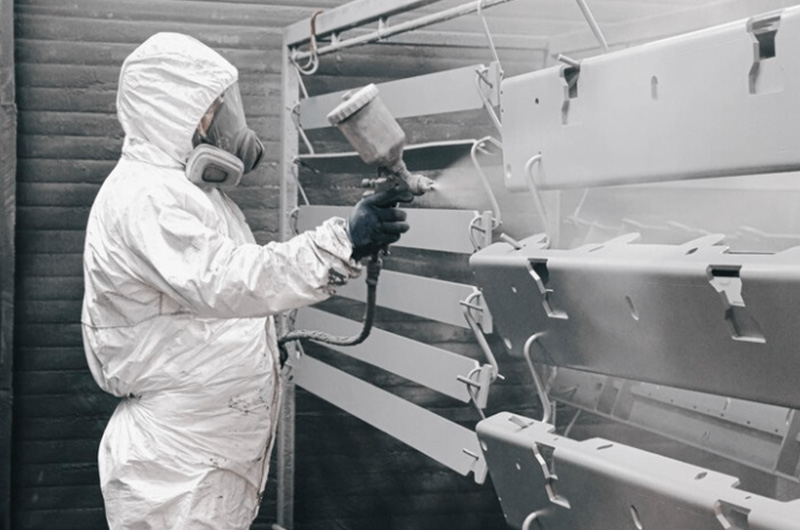
When a finish still goes wrong, diagnose by origin rather than by appearance. Orange peel, pinholing, poor edge coverage, contamination and Faraday-cage thin spots all look like a painting problem and have different causes in geometry, substrate, cure, contamination and earthing. Our powder coating defect guide splits them into those families, which is the order that actually leads to a fix. Two design-level preventers are worth mentioning because they cost nothing at drawing stage: edge condition — a broken edge holds film, a sharp burr does not, see the edge break guide — and hang points, which leave marks and have to be placed where they will not be seen.
Finally, tolerance. A finish has thickness, and a coating of meaningful film build on both faces of a mating pair changes the fit. Where parts assemble after coating, that build belongs in the tolerance stack rather than in a rework instruction; our sheet metal tolerance guide sets out what each process holds and what to dimension.
Approving the first panel is the easy half; holding that colour across later batches is the other, and it takes a delta E limit with its conditions, a gloss tolerance at a stated angle and a signed limit sample.
Say when the hardware goes in, not just what the finish is — and if a hole has to be cut on site, the cut edge needs the coating repaired immediately. Both are covered in the field modification and sealing guide.
Everything above treats pretreatment as one line in a finish specification. It can also be specified stage by stage, and for fabricated enclosures that is where the decision is won or lost: which conversion chemistry on which substrate mix, what gets logged, and why a hem holding solution cannot be dried clean. See the five pretreatment stages and the enclosure geometries that trap them.
Frequently Asked Questions
What is the difference between powder coating and wet painting?
Powder coating applies a dry polymer powder electrostatically and cures it in an oven, producing a thick, uniform, chip-resistant film — commonly specified in the 60–120 µm band. Wet painting sprays liquid paint that air- or oven-dries; it is cheaper for very small batches and easier to colour-match finely, but the film is thinner and softer. Choose powder where the part faces weather or abrasion, and wet paint for indoor, low-wear parts or fine colour work.
Which surface finish is best for outdoor sheet metal parts?
For outdoor steel, the answer is a system rather than a single finish: proper pretreatment, then a durable powder coating, or galvanizing plus powder coating where the site is coastal or humid. Stainless parts can be left as-is and passivated. Whichever you choose, the rating that keeps water out is a separate specification from the finish that resists corrosion — our IP rating guide covers the first and our coatings guide the second.
What is anodizing, and when is it used instead of powder coating?
Anodizing is an electrochemical process that converts the aluminium surface into a thicker, harder oxide; because the layer grows out of the metal it will not chip or peel. Use it on aluminium where you want a metallic appearance, wear resistance or a thin, dimensionally stable layer. Use powder coating where you need colour, higher film build or coverage over substrate defects — anodizing hides nothing.
Can powder coating match a specific brand colour?
Yes. Powder is available in RAL, Pantone and custom-matched colours with gloss, satin and matte textures, and we provide colour chips or sample panels for approval before production. State the gloss target as well as the colour, because two panels can match in colour and still look different under the same light.
Does powder coating stop a part from being earthed?
Yes — the film is an insulator, and a coated lap joint is an aperture, not a bond. If a part needs a bonding path, the contact area must be masked before coating or machined bare afterwards, and that area has to be shown on the drawing so the coater knows where not to spray. Our grounding and bonding guide covers the provisions that work.
How long will a powder-coated part last outdoors?
There is no honest single number, because service life is set by pretreatment quality, film build, substrate and site aggressiveness — and salt spray hours are a comparative screening result, not a weathering prediction. What you can do is specify the system properly and ask for the two things that actually correlate: the pretreatment, and a salt spray result with a stated creepage criterion. Our salt spray guide explains how to read those numbers.
Do I need to worry about coating thickness on parts that assemble?
Yes. Film build is real material, and on a mating pair coated on both faces it consumes clearance that your tolerance stack did not account for. Either mask the mating faces, or dimension the parts with the coating build included. Tight-tolerance features that must stay bare — threads, datums, sealing faces — should be listed as masked on the drawing.
Can SanJun provide a certificate of compliance for a finish?
We supply process records and in-house inspection results, but we are a sheet metal fabricator: we do not run UL 9540A and we do not issue listings or certificates of compliance. Where a project needs a witnessed third-party test or a certificate naming a specific standard, that is agreed at RFQ and run by the named laboratory, and we build and finish to the agreed procedure.
Start your project with the right finish
Send us the drawing, the material, the environment the part will live in and the appearance you need. We will recommend the finish that fits those three, flag the geometry that will cause trouble in the booth, and provide colour chips or sample panels for approval before production. Minimum order quantity is one piece, CAD and DFM review are free, and prototypes ship in 7–15 working days. For how finishing fits the whole sequence, see our nine-step fabrication process, and for schedule drivers the enclosure lead time guide.
Need sheet metal parts with the right finish? Send your drawings today and get a quotation within 24 hours.
An oxygen-cut edge arrives under an oxide film that pretreatment has to remove, so the cut edge condition before coating is a finishing input rather than a cutting preference.
The seam underneath has the same problem one step earlier: coating follows the substrate instead of filling it, so the appearance criteria a weld has to meet before it reaches the paint line decide what the finish can hide.
Finishing sits on top of a material decision and a specification; the base metal, the diagnosis of defects and the cosmetic class are grouped in the materials and finishing cluster.