Scrap-based electric arc steel and ore-based blast furnace steel differ by roughly a factor of three before either one reaches our door, and that route choice — not our laser, not our oven, not how carefully we nest — decides the embodied carbon of a low carbon steel enclosure. On a typical 180 kg outdoor cabinet, which buys about 230 kg of coil once nesting loss and edge trim are counted, swapping integrated for scrap-based steel moves roughly 380 kg CO2e at the crude-steel stage alone — more than the fabrication, coating and freight footprint of the same part combined. Awkward for a fabricator to admit, so it comes first: the route numbers, why recycled content is not the scrap ratio, the EPD fields to request, where CBAM stands in 2026, and the levers a shop can pull.
Key takeaways
- Route beats process. Public worldsteel life-cycle indicators put BF-BOF near 2.34 and scrap-EAF near 0.69 t CO2e per tonne of crude steel. These are industry averages for the dataset year worldsteel publishes — check the current release before you quote any of them to a customer.
- Scrap ratio is not recycled content. One is the furnace charge, the other a declared product property.
- Ask for the module boundary, not the headline. An A1–A3 EPD and one that has netted Module D differ in meaning.
- CBAM's definitive regime started 1 January 2026, but certificates are not sold until February 2027 and the first declaration is due 30 September 2027.
- Downstream scope is still in trilogue. Check your CN code before accepting a yes or no.
Where the carbon in a steel enclosure actually sits
Steel carries roughly 7 percent of global greenhouse gas emissions, and the largest variable is the route: an integrated mill reduces ore with coke and refines hot metal in a basic oxygen furnace, while an electric arc furnace melts scrap with electricity — chemistry versus grid mix.
| Route | CO2e per t crude steel | Expanded GHG | Scrap in charge | For the buyer |
|---|---|---|---|---|
| BF-BOF | ~2.34 | ~2.66 | 20–30% | Asian coil default; worst on CBAM defaults |
| Scrap-EAF | ~0.69 | ~0.71 | Up to 100% | Lowest, but grid-dependent |
| DRI-EAF | ~1.47 | ~1.66 | Low | Drops only with hydrogen |
| Global average | ~1.92 | ~2.18 | — | Use only with no mill data |
Industry averages, not mill claims.
What the numbers do and do not cover
They stop at the crude-steel stage; the rest sits on top. Work from purchased mass rather than finished mass. That 230 kg of coil carries about 540 kg CO2e at the BF-BOF figure and about 160 kg at the scrap-EAF one, against a metered 30–45 kg for our own laser, brake, weld and oven load on a cabinet that size — metered at our plant, not taken from a published factor. A genuinely low carbon steel enclosure means buying a different coil.
Recycled steel content is not the scrap ratio
Scrap ratio is an input measure: the recovered share of the furnace charge. Recycled content is a declared product property, and under the ISO 14021 framing most EPDs use, it splits into post-consumer, pre-consumer and internal mill scrap, which many programmes exclude or weight at half. A mill can run a high scrap ratio and still declare low recycled content, because much of its charge is its own revert. Published declarations for the same product family routinely differ by several times, precisely because one counts internal mill scrap and the other does not: the split between post-consumer, pre-consumer and internal scrap is what you are buying, not the headline.
Ask instead for the content declaration with all three buckets, plus the reporting period, route and plant. One percentage with no split is a talking point.
Low carbon steel enclosure specs: the EPD fields to request
An Environmental Product Declaration (EPD) is a third-party verified, registered document reporting a product's life-cycle impact. The governing standards are ISO 14025 (Type III programme rules) and EN 15804 for construction products, currently EN 15804+A2:2019/AC:2021, with ISO 21930 in North American practice.
The fields that do the work:
- Declared unit and module boundary — A1–A3 is the core. Put the boundary in the RFQ so quotes compare.
- GWP-GHG for A1–A3 in kg CO2e. Published EPDs for EAF-based plate commonly report A1–A3 GWP-GHG in the region of 1 t CO2e per tonne, and a figure near or above 2.0 usually indicates an integrated route. Use that as a sanity check on one specific declaration, not as a substitute for reading it.
- The content declaration, with all three scrap categories separated.
- Programme operator, verifier, validity date.
- Modules A4, C and D if declared — freight, end-of-life, recovered-scrap credit.
- Geographic scope and share of site-specific data. Named-plant data beats a regional average.
Module D is where numbers get slippery. It carries the benefit of steel recovered at end of life, and EN 15804 requires it reported separately, never netted into the A1–C total. A figure with that credit already subtracted is not comparable to one reporting A–C and D side by side — and both carry the same unit.
EU CBAM in 2026: what changed
The transitional phase ended 31 December 2025. The definitive regime applies from 1 January 2026, under Regulation (EU) 2023/956 as amended by Regulation (EU) 2025/2083.
- A 50-tonne de minimis threshold, per importer per year across iron and steel, aluminium, cement and fertilisers; hydrogen and electricity are excluded.
- Authorised declarant status is required to release in-scope goods, and the application has to be filed before the 50-tonne threshold is crossed. Importers who applied by 31 March 2026 were able to keep importing while their national authority decided; if you are reading this later, file before you cross the threshold, not after.
- Actual or default values. Actual emissions need an accredited verifier; defaults are the country average plus a mark-up, deliberately conservative.
- The calendar. Certificates on sale 1 February 2027; the first declaration, for 2026 imports, due 30 September 2027. Quarterly holding fell from 80 to 50 percent. Carbon price paid at origin is deductible if documented and independently certified.
Where fabricated enclosures sit
Annex I lists in-scope iron and steel by CN code, concentrated on primary and semi-finished forms. Whether a finished enclosure is in scope depends on its code: assembled panels and boards commonly sit in Chapter 85, other fabricated steel articles in Chapter 73 or 83. The scope is being widened — the Commission proposed about 180 steel-intensive downstream products in December 2025, the Council added roughly 200 more in June 2026, and the Parliament voted on 15 September 2026 to extend to 457. None of the three lists is law: they are negotiating positions, and the final scope is whatever survives the trilogue. Plan against the widest list, classify against the adopted Annex I. On the Council's timeline 2026 and 2027 scope is unchanged and the extended list applies from 2028, subject to adoption.
Check the CN code, and let nobody answer confidently without it. What is already real is not a certificate bill — it is a data request from your importer, who needs installation-level emissions for the steel inside.
ESPR and the Digital Product Passport
Iron and steel is one of six priority groups in the Commission's first ESPR working plan for 2025–2030, with a delegated act consultation held in 2026. Supporting Joint Research Centre work proposes the heat number as the batch identifier and an ISO 14021-style recycled content declaration. None of it is law. The Commission had not published an adopted delegated act for iron and steel at the time of writing, and ESPR sets an 18-month transition from adoption, so first application is no earlier than 2028. Treat both dates as planning assumptions and re-check before you commit to a compliance date.
Seven levers a sheet metal fabricator can pull
Ranked by how much of the footprint each can move. The first is not ours.
| Lever | Impact | Difficulty | Cost effect |
|---|---|---|---|
| EAF route for part of the tonnage | 40–70% of crude-steel share | High | Material up 5–20% |
| Downgauge or higher-strength grade | 10–30% less mass | Medium | Often neutral or lower |
| Nesting yield on real geometry | 3–12% less tonnage | Low to medium | Lower |
| Segregate and return offcuts | 2–5% | Low | Neutral |
| Powder recovery and low-temp cure | 25–30% less coating energy | Medium | Neutral to lower |
| Surface system vs design life | Varies | Medium | Upfront up, lifecycle down |
| Load factor, packaging, disassembly | 1–5% | Low to medium | Neutral to lower |
The bottom three are ours — and single digits. Anyone quoting 50 percent from nesting and powder recovery is selling something.
Why the coating line is the biggest lever we own
Powder is solvent-free, and modern booths reuse overspray at above 95 percent system efficiency, against first-pass transfer efficiency of roughly 50–70 percent, against 25–65 percent for liquid, which has nothing to reclaim. Low-temperature-cure powders bring cure into the 140–160 °C band and cut oven energy by a quarter to a third. Durability trade-offs are in the powder coating versus liquid painting guide.
The stainless versus carbon steel trade-off
No universal answer, and this is where we most often talk a customer out of a bad idea. Bare stainless removes the coating line and usually outlasts painted carbon steel in coastal or de-icing-salt service, but stainless carries a higher mill footprint per kilogramme, largely from ferrochrome, and annealed austenitic stainless yields lower than cold-rolled carbon steel, so a strength-limited panel needs more thickness than a stiffness-limited one. Twenty years inland: painted carbon steel wins. Fifteen years coastal with repainting every seven: bare stainless wins. See the stainless versus carbon steel enclosure guide and the corrosion resistance coatings guide.
Ten questions to put to your enclosure supplier
- Which mill and route made this coil, on the certificate? "Our steel is green" is not an answer.
- A verified EPD, and what is the module boundary? No EPD with a plan is fine; a fabricated one is not.
- Recycled content split into pre-consumer, post-consumer and internal scrap? One bare percentage is a red flag.
- GWP-GHG for A1–A3, and is Module D reported separately?
- Installation-level emissions in the form an EU importer needs? Watch anyone who confuses verified actuals with CBAM defaults.
- What nesting yield do you expect on this geometry? If nobody ran the nesting before quoting, it is a guess.
- Where do offcuts go — mixed skip or segregated return?
- Coating efficiency and cure schedule?
- What share of the EPD is site-specific, and from which plant?
- Will you hold the same mill and route for the production year?
The supplier who answers "fully compliant" to all ten without asking one question back is the one to worry about. Our sheet metal RFQ checklist has the slot for these.
Where the greenwashing line is
The footprint of a steel enclosure is decided by the mill that made the coil, and the set of mills we can buy at a given gauge, coating, quantity and lead time is narrow. We can improve nesting and recover offcuts; we cannot turn a blast-furnace coil into an electric arc furnace coil by being virtuous. What we can do is say which option is which, show the certificate and EPD behind each, and refuse to number what we cannot evidence.
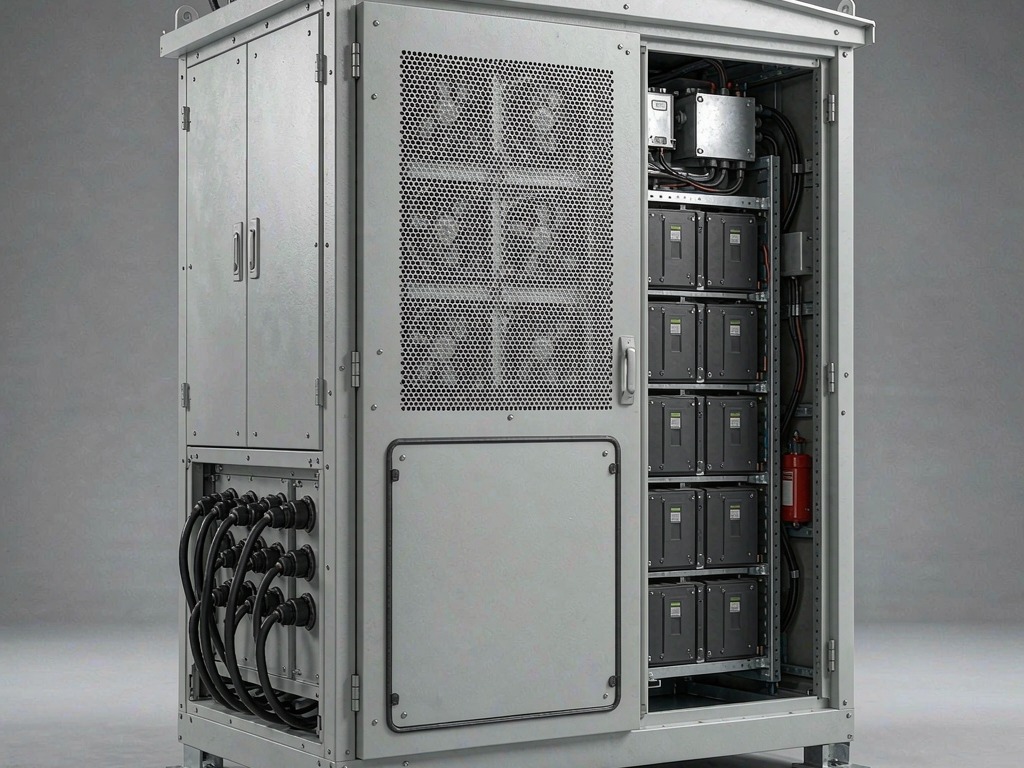
Start with the sheet metal material selection guide and the nesting and material yield guide; for storage volumes, the energy storage cabinet enclosure guide covers the mass drivers. Rank spend by steel mass, not part count, and get module boundaries before price deltas.
Send the drawing, annual volume and today's steel grade: we will return per-unit steel mass, the routes we can genuinely source at your tonnage and a fixed-price quotation within 24 hours, and say up front if verified mill data is not available at your quantity. Low-carbon routes carry longer mill lead times — see the enclosure lead time guide. If you change grade or coating, re-run compliance starting with the RoHS and REACH guide, and if thinning the sheet is part of your plan, check the biggest unsupported panel first — that is usually the door and cover.
Frequently Asked Questions
How much CO2e does a steel enclosure actually carry?
Most of it sits at the mill, not in the factory. Published route-level industry averages put integrated BF-BOF steel near 2.34 t CO2e per tonne of crude steel and scrap-EAF near 0.69, with a global average around 1.92. For a 180 kg enclosure that is roughly 420 kg CO2e versus roughly 125 kg before rolling, fabrication, coating or freight are added. Our own cutting, forming, welding and coating utilities for a part that size run to a few tens of kilogrammes. Ask for the declared unit and the module boundary before comparing two numbers.
Is recycled steel content the same as the scrap ratio?
No, and the gap is often large. Scrap ratio describes the furnace charge. Recycled content is a declared product property, split into post-consumer, pre-consumer and internal scrap, and many programmes exclude internal scrap entirely or weight pre-consumer material at half. One published EPD for hot-rolled coil declares 3.5 percent pre- and post-consumer scrap and 19.6 percent recycled content including internal scrap — the same product, two defensible numbers differing by a factor of five.
What should I request instead of a "green steel" claim?
A third-party verified EPD to ISO 14025 and EN 15804, with the declared unit, the module boundary, GWP-GHG for A1–A3, the content declaration split by scrap type, the programme operator and verifier, and the validity date. Add the mill name, the production route and the share of site-specific data. Also ask whether Module D is reported separately, because a figure with the recycling credit already netted out is not comparable to one that is not.
Do I have to pay CBAM on an imported steel enclosure in 2026?
It depends on the CN code, and for many fabricated enclosures the answer is still being legislated. CBAM entered its definitive regime on 1 January 2026, but the original Annex I scope concentrates on primary and semi-finished iron and steel, while the Commission, Council and Parliament have all proposed adding steel-intensive downstream products, with the Council's timeline pointing at 2028. What is already real is the data request from your importer, who needs installation-level emissions to avoid falling back on conservative default values.
Is a powder-coated carbon steel enclosure lower carbon than bare stainless?
Over a long mild-environment service life, painted carbon steel usually wins on lifetime carbon, because stainless carries a higher mill footprint per kilogramme largely from ferrochrome and needs more mass for equal stiffness. Over fifteen years on a coast with repainting every seven, bare stainless usually wins, because it removes the coating line and the maintenance repaints. Run it on your actual design life and maintenance interval rather than assuming either one.