Every outdoor cabinet, every BESS enclosure, every EV charging pile has the same quiet problem: get heat out without letting weather, dust and noise in. The vent panel looks like a simple sheet of holes, but the open area ratio, hole geometry, fan curve and structural reinforcement all have to line up — or the enclosure either overheats, leaks, or arrives at site bent. This guide is how SanJun Hardware engineers perforated vent panels for the cabinets we ship every week.
Why Vents Are Not Just Holes
Three forces compete on every vent panel you cut:
- Thermal. More open area means more airflow means cooler internal components — until static pressure drops and the fan stalls.
- Structural. Every hole removes material that was carrying load. A 60% open area panel in 2 mm steel is genuinely floppy.
- Environmental. IP54, IP65, dust, salt spray, noise, EMC — each one puts a constraint on what the perforation is allowed to look like.
The art of vent panel design is balancing the three against each other, not picking one and ignoring the others. Most of the rework we see on customer drawings is somebody optimizing for one and breaking the other two.
Open Area Ratio: The Number That Drives Everything
The open area ratio (OAR) is the percentage of the panel area that is hole. A 5 mm round hole on a 7 mm staggered pitch gives about 46% OAR; the same hole on a 6 mm pitch gives 64%.
The practical bands we use at SanJun:
- 30–40% OAR — minimum for effective convection cooling on natural-draft enclosures. Rarely enough for forced-air applications.
- 40–50% OAR — the sweet spot for most general-purpose electronics enclosures. Good airflow, panel still has plenty of stiffness.
- 50–60% OAR — for high-power BESS racks, dense telecom chassis and outdoor inverter cabinets. Needs stiffening ribs or return flanges.
- 60%+ OAR — only used on internal baffles and shield panels where the outer skin is doing the structural work. A bare panel at 60% will oil-can under finger pressure.
Hole Geometry: Round, Square, Hex, Slotted
Each shape has a personality.
Round Holes — The Default
Round holes on a staggered pitch are the workhorse. They are easy to pierce, the tooling is cheap, and the airflow is predictable. They are also the easiest to gasket and the easiest to keep burr-free after laser cutting. For most enclosures we recommend starting here.
Hex / Honeycomb — For High Open Area
Hexagonal cells can hit 70–80% open area while keeping the bridges between cells in tension rather than bending. That makes them structurally efficient. We use honeycomb patterns on dense server racks and BESS cabinets where every percentage point of open area matters. The trade-off is tooling cost — honeycomb punches are noticeably more expensive than round.
Square and Slot Holes — When Form Factor Forces It
Slot and square holes are useful when the vent has to align with components inside the cabinet — a fan grille, a connector array, a heatsink fin stack. They are also a common callout when a customer is copying a competitor's existing design. The downside is that corners concentrate stress, so we usually step down to a smaller open area ratio to compensate.
Louver Slots — When Water Shedding Matters
Formed louvers are not really "holes" in the same sense — they are bent slots that point downward, so water runs off the outside of the panel rather than into it. A louver panel can deliver IP54 protection with no gasket, and IP65 with a foam filter behind it. We use louvers on outdoor EV charging posts, telecom cabinets and any enclosure that faces horizontal rain.
Matching the Fan Curve to the Vent
Selecting the fan is only half the battle. The vent has to be matched to it.
A fan produces a certain cubic-feet-per-minute (CFM) at zero static pressure, and that CFM drops as back-pressure rises. The system operating point is where the fan curve crosses the system impedance curve — and that impedance is mostly set by the vent panel. A panel with too many small holes acts like a wall; the fan stalls, the electronics cook, and the fan burns out trying.
The rule of thumb we give customers:
- Keep airflow velocity at the vent under 7 m/s where possible.
- For high-static-pressure fans (servers, telecom), target 50%+ OAR with large round or hex holes.
- For low-noise fans (HMI panels, indoor cabinets), use larger holes at lower density rather than many small holes.
Structural Reinforcement for High OAR Panels
A panel that is 50% holes is not stiff enough to survive shipping and rack-mounting by itself. The fix is almost always one of three options, in increasing order of cost:
- Return flanges around the perforation field. A 10–15 mm unperforated border with a 90° bend stiffens the panel dramatically without adding parts.
- Formed stiffening ribs. A few longitudinal or cross-direction pressed ribs turn a floppy panel into a torsion box. Easy to do on a press brake, costs almost nothing in tooling.
- Internal sub-frame. For the most demanding cabinets (large BESS racks, 19-inch telecom frames), a separate internal frame carries the structural load and the perforated panel is a cosmetic / airflow skin.
Outdoor Considerations: IP, Salt Spray, EMC
Once a cabinet leaves the factory floor, the vent panel has to keep performing in weather.
- IP rating — IP54 is straightforward with a perforated panel plus filter mat. IP65 needs louvers that shed water, a separate baffle chamber, or gasketed vent covers. We always confirm the IP target before tooling.
- Salt spray — coastal and offshore cabinets need either aluminum (anodized) or galvanized steel with a powder-coat over the perforated area. Bare cold-rolled steel will rust through a perforation field in under 12 months at the coast.
- EMC shielding — a perforated panel breaks the Faraday cage. If the cabinet needs EMC shielding, the panel has to be either very thin (skin depth at the relevant frequency) or backed with a conductive gasket and a separate shield mesh. We can do both, but it changes the design.
DFM Checklist for a Vent Panel
Before we put a vent panel into production, we run through this list with the customer's drawing:
- Hole diameter is at least equal to material thickness (clean cutting, no burn-through).
- Pitch gives the target open area ratio (40–50% for most uses).
- Hole edges are at least 1.5× thickness from any bend line or free edge.
- Pattern direction is called out (staggered orientation vs aligned).
- Border zones around the perforation field are at least 10 mm wide.
- Material thickness is standard stock (1.0, 1.2, 1.5, 2.0, 2.5, 3.0 mm).
- Surface finish matches environment (powder coat, anodize, zinc plating).
- IP target is specified — drives whether we add louvers, baffles or filters.
- Fan CFM and static pressure target is on the drawing.
- Acoustic target is on the drawing (we cap velocity at 7 m/s where possible).
How SanJun Builds Vent Panels
Two production paths, one quality bar.
Turret Punch or Laser for Holes
For round and hex patterns up to 50% OAR, we run turret punching — fast, repeatable, low tooling cost. For complex shapes, slot patterns or panels above 50% OAR, we switch to fiber laser cutting. Both paths produce a clean, burr-free hole that does not need any secondary deburring before powder coating.
Bending on a Press Brake
Most vent panels need at least one bend — a return flange, a stiffening rib, a mounting lip. We form these on a CNC press brake with bend sequencing controlled to ±0.5° around the perforation field, so the panel stays flat and the pattern does not distort.
Surface Finish That Lasts
Powder coating over a perforated field needs care — the spray has to wrap into the holes and the cure has to be even so the edges are not left brittle. We run an outdoor-grade polyester powder coat (60–80 μm) on most perforated panels, with pre-treatment that includes a zinc-rich primer for coastal cabinets.
Where This Matters in Our Product Lines
Vent panel engineering shows up across most of what we make:
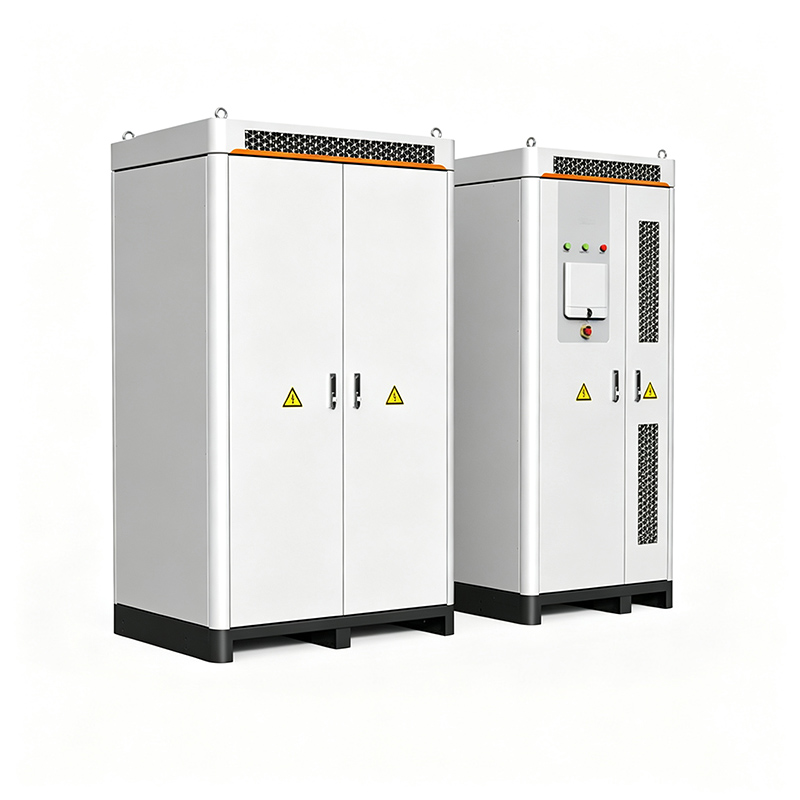
- Energy storage cabinets (BESS) — perforated top and side panels for air-cooled racks, louver vents for outdoor containers.
- EV charging pile enclosures — louver vents on the side panels for heat shedding, hidden behind cosmetic bezels.
- Industrial control cabinets — perforated door panels for control electronics, often with a removable filter mat.
- Telecom and network cabinets — high-OAR panels for dense 19-inch racks (the dimensional envelope is in our rack dimensions guide), with EMC gasket grooves designed in.
- Outdoor security and municipal enclosures — heavy-duty louver panels that shed rain and resist vandalism.
If your cabinet needs to breathe, the vent panel is doing the breathing. We would rather design it once and get it right than rework it on every shipment.
Open area is one half of the vent problem; the other half is the airflow the chassis actually has to pass. The arithmetic behind it, and how it becomes a hole pattern on a rack chassis, is in 2U rack chassis cooling.
Frequently Asked Questions
What open area ratio should I target for a perforated vent panel?
For most general-purpose enclosures 40–50% open area is the sweet spot. Honeycomb and staggered round patterns can reach 55–60% if you reinforce the bridges. Above 60%, you almost always need formed ribs or return flanges to keep the panel flat.
Can perforated vents still meet IP54 or IP65?
IP54 is straightforward with a perforated panel plus a filter mat. IP65 needs either louvers that shed water downward, a separate baffle chamber, or gasketed vent covers that close when the fans stop. Bare perforated holes will leak under jet spray regardless of hole size.
How do I avoid acoustic noise from perforated panels?
Keep airflow velocity below 7 m/s where possible, use larger hole diameters rather than many small holes, and avoid placing vents directly opposite a fan intake. Staggered patterns are quieter than aligned square grids at the same open area.
Do perforated panels weaken the enclosure structurally?
Yes, but less than people think. A 50% open area panel in 2 mm cold-rolled steel retains roughly 60% of the bending stiffness of a solid panel. The fix for highly perforated panels is formed stiffening ribs or return flanges around the perforation field.
Conclusion
A perforated vent panel is where thermal, structural and environmental engineering meet. Get the open area ratio right, match the hole geometry to the fan, reinforce the panel where it needs stiffness, and finish it for the environment it is going into. Send us your STEP file and airflow requirement and we will run a free DFM review and return a quotation — usually the same day.
Need a vent panel that actually moves air? Send us your drawing for a free DFM review and a production quotation.
A pattern is one part of a thermal budget; the sizing, the vent selection and the safety-venting cases around it are collected in the thermal management cluster.