Metal stamping turns flat sheet or coil into precise, repeatable parts at high speed — brackets, contacts, shielding cans, bezels, busbars and the hundreds of small parts inside every enclosure. Its economics are unusual: you pay for hardened tooling up front, and in exchange the unit price keeps falling the more parts you make. That trade is either the best decision in your bill of materials or an expensive mistake, and what separates the two is almost never the process — it is whether the drawing was frozen before the tool steel was cut, and whether the forecast volume was real. This guide covers what a press actually does, which die type fits which part, the tolerances stamping genuinely holds, and the break-even arithmetic to run before you ask for a quote.
Key takeaways
- A die is a bet on volume and on a frozen drawing. Stamping wins on unit price only after the tooling has paid back, and a geometry change after the steel is cut cascades through the entire strip layout.
- Die type follows part geometry and volume, not preference: single-station for simple blanks, compound for flat precision parts, progressive for complex high-volume work, transfer for large or deep-drawn parts.
- Stamping holds roughly ±0.05–0.15 mm depending on material thickness and feature, with pierced holes near ±0.05 mm in a progressive die — a turret-punched hole sits nearer ±0.1 mm. Anything tighter is not a standard production figure — it is a project with secondary operations attached.
- The thickness envelope narrows at both ends. Progressive tooling is comfortable to about 6 mm; below roughly 0.5 mm a laser stops being the safe default because heat distorts thin stock, so shims and vent plates get stamped even at modest volumes.
- SanJun runs stamping, fabrication and finishing under one roof. We design, build and try out tooling and we hold inspection records, but we are a sheet metal fabricator — we do not run UL 9540A, and we do not issue listings or certificates of compliance.
What is precision metal stamping, and what does the press actually do?
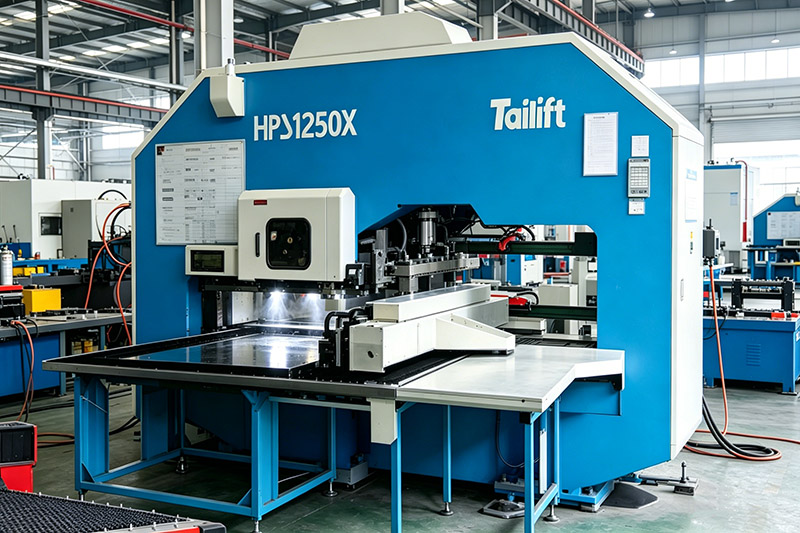
A press forces sheet stock through or between a punch and a die made of hardened tool steel. Everything distinctive about stamping follows from that: the geometry lives in the tool, not in a program. A single-station die performs one operation per stroke; a progressive die feeds a strip forward one pitch per stroke through stations that pierce, notch, form, coin, restrike and blank, so a finished part drops off every cycle. Presses run from around a hundred to several hundred strokes a minute.
Two consequences matter. First, stamping forms as it cuts — bends, ribs, lances, coining and even in-die tapping can happen in the same pass, so a part needing four steps on a laser-and-brake route can leave the press finished. Second, repeatability comes from the tool and drift comes from tool wear: once a die is proven, part-to-part variation is set by tool steel wear rather than process instability, which is why a long stamped run holds its window tighter than a thermal cutting process. Where that window sits is covered below; for the surrounding steps see our nine-step fabrication process.
Which die type fits your part?
Four die families cover almost all sheet metal work, and the choice follows part geometry plus volume rather than supplier preference. The cost and lead-time bands below are published figures for general sheet metal work, not a quotation.
| Die type | How it works | Best for | Tooling cost band | Lead time to first part | Limits |
|---|---|---|---|---|---|
| Single-station / blanking die | One operation per press stroke — usually blank or pierce. | Simple flat blanks and low volume. | Low thousands of USD. | About 4–8 weeks. | Slow; each extra feature adds a handling step. |
| Compound die | Two or more operations, such as blanking and piercing, in one stroke. | Flat, simple, high-precision parts where features must be concentric. | Low to mid thousands of USD. | Similar to a simple die. | Flat parts only; it will not form or draw. |
| Progressive die | A strip indexes one pitch per stroke through multiple stations; a finished part drops off every cycle. | Complex parts in sustained volume. | Tens of thousands of USD; complex tools can exceed USD 100,000. | Roughly 8–16 weeks or more, plus tryout. | Expensive to change — the strip layout fixes operation sequence. |
| Transfer die | Pre-cut blanks move mechanically between stations. | Large or deep-drawn parts that cannot ride a carrier strip. | Mid to high by station count. | Comparable to a progressive die. | Slower than progressive; more mechanism to maintain. |
"Complex" in practice means station count. A progressive die for a precision front bezel typically runs six to twelve stations — pierce, blank, pilot, bend, restrike, coin — with the strip indexed to within 0.02 mm at every station. That indexing figure is a property of the tool, not a tolerance you can call out on a part drawing; conflating the two is a common source of an unquotable specification. Our touchscreen bezel stamping guide walks through that sequence, including the coining operation that makes a flush joint possible.
What tolerances can stamping actually hold?
This is where stamping gets oversold. The honest answer is a band, not a number, set by material thickness, feature type and how many stations sit between a feature and the datum that locates it.
| Feature | Typical window | What actually drives it |
|---|---|---|
| Pierced hole diameter | Around ±0.05 mm | Punch-to-die clearance, tool steel condition, thickness and hardness. |
| General linear dimensions | Roughly ±0.05–0.15 mm | Thicker stock and harder alloys open the window; thin mild steel closes it. |
| Bend angle | Around ±1° | Springback: sheet relaxes after the tool releases — commonly 1°–3° on a sharp bend, more on hard alloys — so the tool over-bends by a calculated angle. |
| Hole-to-hole, same station | Tightest case: features piloted together in one hit | Both features are located by the same tooling, so no strip accumulation error applies. |
| Hole-to-hole, across stations | Wider than the same-station case | Every station adds its own piloting error; features that must relate tightly should be pierced together. |
| Flatness on long, thin edges | The hardest one to hold | Long edges bow, twist and oil-can after forming. The fix is structural — micro-ribs or return flanges — not a tighter tolerance callout. |
One number deserves a direct warning. You will see ±0.02 mm quoted for stamping, and there is a real figure behind it — the strip indexing accuracy inside a progressive tool. It is not a part tolerance you can specify on a drawing. On our sheet metal tolerance guide, ±0.02 mm on a hole position is the point at which a fabricator is forced into secondary machining, extra inspection, hand fitting or part-by-part sorting — each adding cost without necessarily adding quality. The practical rule is unchanged: ask for precision only where the assembly needs it, and let ISO 2768-m carry everything else. A drawing that calls a tight tolerance on every dimension can push the part's price up substantially with no functional benefit, and still will not guarantee the part holds those numbers in production.
What materials and thicknesses stamp well?
Material selection for stamping differs from material selection for the finished product, because the alloy changes what the die must survive. Stainless work-hardens and wears die steel, raising tooling cost — one reason stainless parts stay on a laser longer than volume alone suggests. Aluminium galls in a die and needs coatings and lubrication. Mild steel is the easiest of all.
| Material | How it behaves in the die | Practical notes |
|---|---|---|
| Cold-rolled steel (SPCC / DC01) | Stamps cleanly, holds the tightest standard window, predictable springback. | The default for brackets, panels and structural parts. Takes powder coating without drama; see the corrosion resistance guide. |
| Galvanized steel | Similar to mild steel; the zinc layer is abrasive over a long run. | Good for cost-sensitive outdoor parts. Watch zinc build-up on the tool; see powder coating versus liquid painting. |
| Stainless steel 304 / 316 | Work-hardens and wears die steel; springback is higher. | Allow a larger inside bend radius — around 1.5× thickness — and budget extra springback. Correct for food, medical, washdown and coastal work. |
| Aluminium (5052-H32, 6061-T6) | Galls in a die; needs tool coatings and lubrication. Higher springback than steel. | Right where weight, heat spreading or anodizing matters. Hard 6061-T6 wants a larger bend radius — around 2× thickness. |
| Copper and brass | Soft and formable; stamps cleanly. | Used for contacts, terminals and busbars where conductivity is the requirement. Bare copper tarnishes, so state handling and storage needs at RFQ. |
Thickness sets the envelope at both ends. Progressive stamping is comfortable to about 6 mm; beyond that press tonnage and tool design stop being economical. At the thin end the constraint comes from the alternative process: below roughly 0.5 mm, laser cutting stops being the safe default because heat distorts thin stock, which is why shims and vent plates get stamped even at modest volumes. Standard stock runs roughly 0.1 mm to 6 mm depending on alloy, and staying on standard mill stock matters more than most buyers expect — a 1.7 mm special is a sourcing problem first. Our material selection guide covers the wider trade-off; where dissimilar metals will meet in the assembly, see the galvanic corrosion guide.
When does stamping beat laser cutting — and when does it not?
The decision is not which process is better; it is at what quantity the tooling pays back, and whether the drawing has stopped moving. A laser has no tooling cost and a per-part cost that barely moves from five to five thousand pieces. Stamping inverts that: high one-off tooling, then a very low unit price.
| Annual volume | Usually the better route | Why |
|---|---|---|
| Prototype, 1–20 pcs | Laser cutting | Nothing to amortise, and the design is still moving. A die built on an unfrozen drawing is a sunk cost with a rework bill attached. |
| Pilot run, 100–500 pcs | Laser cutting in most cases | The die rarely pays back. A simple die is worth quoting only if the geometry is genuinely frozen. |
| Production, 1,000–10,000 pcs | Quote both, compare the curves | Where the crossover usually sits for small, flat parts. Large, slow-cutting parts stay laser-competitive well past it. |
| 10,000–50,000+ pcs | Stamping | The die is amortised; press speed and very low labour per part take over. |
| High volume, design still changing | Laser — delay the die | Volume alone does not justify tooling if the geometry is not settled. |
One exception is worth noting: below about 0.5 mm, heat distortion makes a laser the riskier choice regardless of quantity. Our laser cutting versus stamping comparison covers the full five-dimension comparison.
What does tooling cost, and where is the break-even point?
The break-even is arithmetic you can run before requesting a quote, and it is worth more than any rule of thumb:
Break-even quantity = tooling cost ÷ (laser unit price − stamped unit price)
A small bracket costing USD 2.50 laser cut and USD 0.50 stamped, with the die quoted at USD 8,000, saves USD 2.00 per part — so the die pays back at 4,000 pieces. Change one input: if the part cuts in ten seconds rather than two minutes, the laser price might fall to USD 0.90, the saving shrinks to USD 0.40, and the crossover moves past 20,000 pieces. Same die, different answer.
Two more inputs move it. Material yield — a laser nests several part numbers across a sheet but leaves skeleton between them, while a die runs a narrow strip and wastes mostly the carrier. And order pattern: the same annual volume delivered as one order amortises a die differently from twelve monthly releases, because the tool must be stored, maintained and re-proven between runs. Both appear as line items in a proper quote — see our custom enclosure cost guide.
How do you design a part so the die works first time?
Stamping is the least forgiving sheet metal process, because the operation sequence is fixed in the tool before anyone sees a part. The checks below catch the most problems, and most cost nothing at drawing stage:
- Freeze the drawing first. Validate the geometry with laser-cut samples, then release the die — the single decision that protects the tooling budget.
- Inside bend radius at least 1× material thickness — around 1.5× for stainless and 2× for hard 6061-T6. Tighter radii crack and accelerate tool wear.
- Keep hole edges clear of bend lines — at least 2× thickness plus the bend radius, or the hole distorts as material flows.
- Use standard mill stock — a non-standard thickness is a sourcing delay before it is a tooling cost.
- Pierce features that must relate together in the same station. This is how you avoid accumulating piloting error across the strip.
- Single-source critical surfaces rather than tightening every tolerance. On a precision frame, the fix for stack-up is to design so one feature controls the critical dimension — not to tighten all of them, which just makes the part uneconomical.
- Add ribs or return flanges where a long, thin edge must stay flat — flatness is a structural problem solved with geometry.
- State burr direction where it matters. A burr on a mating face or a sealing surface is a functional defect, and it is free to specify and expensive to fix later.
Most of these are general sheet metal discipline that matters more when a die is involved; our DFM design guide covers the full set, with bend guidance in the bending guide and the press brake calculator. For long spans see the stiffener and rib guide, and for corners the hem, bend relief and corner joint guide.
Which secondary operations does a stamped part still need?
Stamping removes more downstream work than any other sheet metal process, but rarely all of it. What typically remains:
- Threading. In-die tapping can remove a separate operation; otherwise tapping follows the press.
- Edge break and deburring. Stamped edges carry a burr; where the edge is a mating, sealing or handling surface it has to come off — see our edge break and deburring guide.
- Welding and fastener installation. Inserts, studs and brackets, plus self-clinching hardware. Welding a stamped part brings distortion risk; see the welding guide and the weld distortion control guide, and for hardware the fastener selection guide.
- Finishing. Powder coating, plating or anodizing. A finish has thickness: on a mating pair coated on both faces it consumes clearance your tolerance stack did not account for. See our surface finishing guide and corrosion resistance guide cover the choice.
A supplier that handles stamping, fabrication and finishing in-house removes the hand-offs between these steps — fewer transports and queues, and one party accountable for the finished part rather than three.
How are stamped parts inspected and verified?
Verification answers two different questions, and they need different tools. The first is is this batch inside the window — answered at the press with go/no-go gauging and periodic dimensional checks, because once a die is proven the variation comes from tool wear rather than process drift. The second is does the first article meet the drawing — answered with a first-article inspection report, typically a CMM scan of the critical features, plus a flatness check on any critical seating surface.
Specify those two separately on the RFQ: a batch can be gauged quickly at the press for a few critical features, while a full first-article report is a slower, documented exercise. How to write a plan worth running is set out in our qualification test plan guide and the quality control and inspection guide.
On documentation, the boundary is worth stating plainly. SanJun builds and tries out tooling, runs the press and holds inspection records. We are a sheet metal fabricator: we do not run UL 9540A, and we do not issue listings or certificates of compliance. Where a project needs a witnessed third-party test or a certificate naming a specific standard, that is agreed at RFQ and run by the named laboratory, and we build and finish to the agreed procedure.
What should a stamping RFQ actually contain?
The quality of a stamping quote is set by the quality of the enquiry, because everything a supplier must guess becomes risk priced into the tooling. A complete RFQ states:
- A frozen drawing in a neutral format, revision controlled.
- Material and thickness, preferably from standard mill stock.
- Annual volume and order pattern — total quantity, release size and frequency.
- Critical features called out; everything else left to ISO 2768-m.
- Secondary operations — threading, hardware, welding, finishing.
- Finish specification as a system: process, pretreatment, film thickness, colour, gloss and masked areas.
- Inspection requirement — first-article report, in-process gauging, or both.
- Target date, so die lead time can be planned backwards.
Our RFQ checklist turns this into a fill-in form; the path from first sample to production release is in the prototyping to production guide, and schedule drivers in the enclosure lead time guide.
Frequently Asked Questions
What is the difference between progressive and compound stamping dies?
A progressive die feeds a strip forward one pitch per stroke through several stations, each performing one operation, so a finished part drops off every cycle — best for complex parts in sustained volume. A compound die performs two or more operations, such as blanking and piercing, in one stroke, best for flat, simple, high-precision parts where features must be concentric.
What tolerances can precision metal stamping hold?
Roughly ±0.05–0.15 mm depending on thickness and feature, with pierced hole diameters near ±0.05 mm in a progressive die (a turret-punched hole sits nearer ±0.1 mm) and bend angles around ±1°. If you see ±0.02 mm quoted, be careful — that is strip indexing accuracy inside the tool, not a part tolerance you can specify on a drawing. Tighter values force secondary machining and hand sorting, so use them only where the assembly needs them.
How much does a metal stamping die cost?
A simple blanking die sits in the low thousands of USD; a progressive die is typically tens of thousands, and complex tools can exceed USD 100,000. The die is amortised across the run, so what matters is not the absolute number but the break-even quantity: tooling cost divided by the per-part saving against your current process.
When should I choose stamping instead of laser cutting?
Choose stamping when the geometry is frozen, annual volume is high enough to amortise the die, and you want the lowest unit price on a long run. Choose laser cutting for prototypes, low volumes, thick plate and designs still changing. One exception: below about 0.5 mm, laser heat can distort the part, so thin shims and vent plates are often stamped even at modest volumes.
What materials can be stamped, and how thin or thick?
Cold-rolled steel, galvanized steel, stainless 304 and 316, aluminium 5052-H32 and 6061-T6, copper and brass are all stampable, typically from about 0.1 mm to 6 mm depending on alloy and design; progressive tooling is comfortable to about 6 mm. Material changes tooling cost: stainless work-hardens and wears die steel, aluminium galls and needs coatings and lubrication, and mild steel is the easiest of all.
Can you stamp a part that also needs bending, tapping and welding?
Yes — doing it in one place is usually the point. A progressive die can bend, form, coin and sometimes tap in the same pass. What typically remains is edge deburring, welding of inserts or brackets, installation of self-clinching hardware, and finishing. Having stamping, fabrication and finishing under one roof removes the hand-offs between them.
How long does it take to get the first stamped part?
Die lead time, not press time, sets the schedule — commonly 4–8 weeks for a simple die and 8–16 weeks or more for a progressive die, plus tryout and sample approval. A laser-cut sample is a matter of days, which is why the standard route is to prove the design with laser samples first, then release the die.
Can SanJun provide inspection reports or a certificate of compliance for stamped parts?
We supply first-article inspection reports covering critical features, in-process gauging records and flatness checks where needed. We do not issue listings or certificates of compliance, and we do not run UL 9540A — we are a sheet metal fabricator. Where a project needs a witnessed third-party test or a certificate naming a specific standard, that is agreed at RFQ and run by the named laboratory.
Start your stamping project
Send us the drawing, the material, your annual volume and order pattern, and the finish needed. We review manufacturability before quoting, recommend the die strategy that fits the volume, flag geometry that will cause trouble in the tool, and quote tooling and piece price together so you can see the break-even rather than guess at it. Minimum order quantity is one piece, CAD and DFM review are free, prototypes ship in 7–15 working days, and tooling lead times are confirmed at DFM.
Need precision stamped metal parts? Send your drawings today and get a quotation within 24 hours.