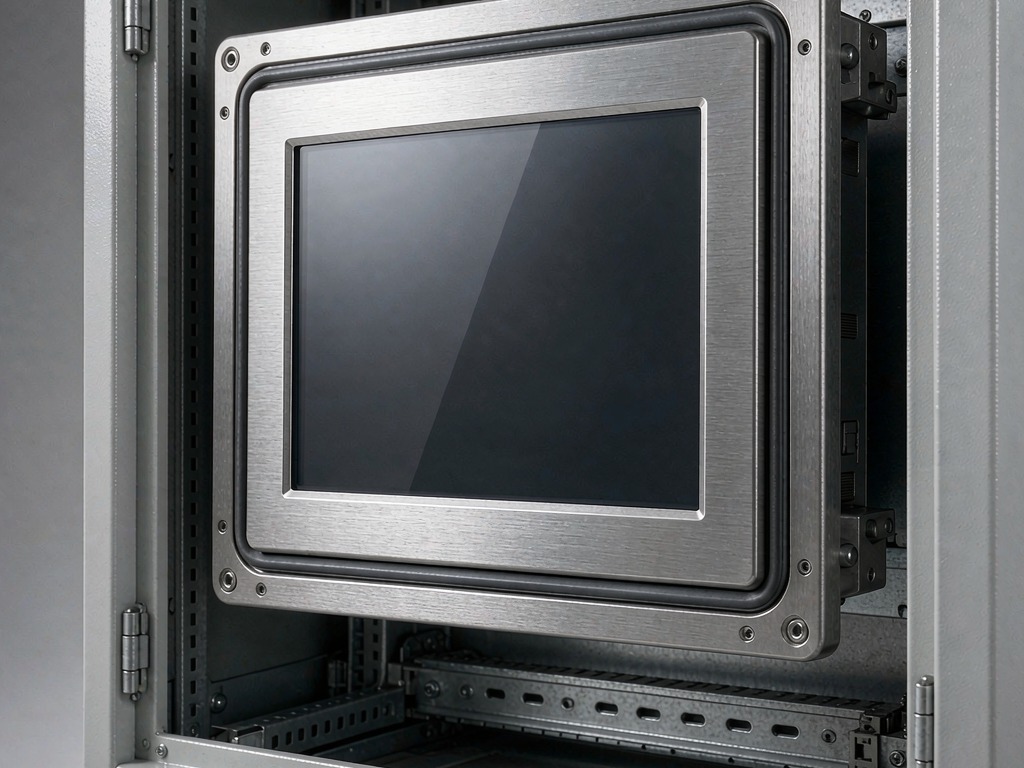
A modern touchscreen bezel has a quietly demanding job: hold the glass flat and square under continuous finger pressure, survive thermal cycling from −20 °C to +60 °C, and still look like a single piece of product. Most glass-cracking, IP-leak and yellow-line defects we see in the field trace back to one root cause — the bezel frame was made looser than the application needed. This guide walks through how SanJun Hardware engineers tight-tolerance sheet metal stamping so the bezel disappears, mechanically and visually, behind the glass.
Why a Touchscreen Bezel Is a Different Animal
Most sheet metal parts are forgiving. A chassis panel out of flat by 0.3 mm still bolts to a frame. A bezel out of flat by 0.3 mm transfers that error straight into the glass it is clamping, and the glass does not forgive. Three behaviors make bezels hard:
- It is a precision mating part. The glass panel sits in a groove or against a sealing surface. Every tenth of a millimetre of bezel distortion becomes a tenth of a millimetre of uneven clamping pressure on the glass edge.
- It frames a visual surface. Edge gaps show. Step changes between glass and frame show. Anything that looks like a seam will be measured by users, not inspectors.
- It carries the IP or NEMA rating. A bezel that wobbles by 0.2 mm breaks the gasket seal every time, and water does not care how good your gasket compound is.
The implication: a touchscreen bezel is a precision part that has to be made on production tooling, not a sheet-metal bracket that happens to hold a screen. That changes everything from drawing review to inspection.
Three Failure Modes We See Most Often
1. Tolerance Stack-Up Across the Frame
Most bezels are not a single piece — they are a stamped front frame, a back plate, four corner brackets and a few side rails. Each one is cut, bent and pierced within its own ±0.1 mm window. When you stack four or five of those windows together, the cumulative error at the glass seating surface can land anywhere from ±0.2 mm to ±0.5 mm.
That is enough to either crush the glass on one side or leave a visible light line on the other. The fix is not "tighten every tolerance" — that just makes the part uneconomical. The fix is single-source the critical seating surface: design the bezel so the glass only ever touches one feature, on one part, with one tolerance window.
2. Springback After Stamping
Sheet metal is elastic. When you bend it, the inside surface compresses and the outside surface stretches. After the tool releases, the part relaxes — usually by one to three degrees on a sharp bend, more on hard alloys. If you stamp a bezel with a 90° bend and assume it stays at 90°, you will assemble it at 91° or 92°, and the resulting gap shows up immediately.
SanJun handles this in two ways. First, our tool designers over-bend by a calculated angle (typically 1°–3° depending on material and thickness) so the final angle lands where the drawing says it should. Second, on high-volume runs we run a first-article CMM scan and feed the actual measured angles back into the press program for the rest of the batch.
3. Flatness Loss on Long Edges
A 24-inch or 32-inch bezel is mostly long, thin edges — exactly the geometry that wants to bow, twist and oil-can after stamping. The fix is structural: integrate micro-ribs or return flanges along the inside edges of the bezel. They add perhaps 30 g of weight and 60 seconds of forming time, and they keep the glass seating surface flat across the entire length.
For a 32-inch self-ordering kiosk that sits in a shopping-mall corridor, this single design decision is usually the difference between a bezel that ships and one that comes back.
The Stamping Process at SanJun
Our production line for bezels runs four steps, with a quality gate between each.
Step 1 — DFM Review Before Tooling
The biggest cost on a custom bezel is the progressive die. Once it is cut, every change is expensive. So we run a 30-minute DFM review on every bezel drawing before quoting. The five things we always check:
- Inside bend radius ≥ 1× material thickness (1.5× for stainless, 2× for hard 6061-T6).
- Hole edges ≥ 2× thickness + radius from any bend line.
- Gasket groove geometry is producible without secondary machining.
- Glass seating surface is on a single feature, not a stack-up.
- Material and thickness are standard mill stock (no 1.7 mm specials).
If we find issues, we send back a marked-up drawing with a suggested fix. About 60% of new bezel drawings we see need at least one of these corrections.
Step 2 — Progressive Die Stamping
For volumes above ~500 pieces, we run the bezel on a progressive die. A single strip of cold-rolled steel or aluminum feeds through 6 to 12 stations: pierce, blank, pilot, bend, restrike, coin. The advantage is consistency — every bezel comes off the press within the same dimensional window, because the die is hardened steel and the strip is indexed to within 0.02 mm at every station.
Coining is the operation that makes a flush touchscreen bezel possible. A high-tonnage coining station presses the outer radius profile flat to within 0.05 mm — tight enough that the bezel-to-glass joint looks like one continuous surface under normal lighting.
Step 3 — CNC Bending for Prototypes and Small Batches
Below ~500 pieces, progressive die economics do not work. We switch to laser-cut flat patterns plus CNC press-brake bending. The tolerance is slightly looser (±0.15 mm rather than ±0.1 mm), but for prototypes, pilot runs and small commercial batches, it is the right cost trade. The lead time is also shorter — typically 5–7 days versus 3–4 weeks for a new progressive die.
Step 4 — Inspection: CMM, Flatness, Surface Finish
Every production batch leaves the floor with a first-article CMM report covering critical features, plus a flatness scan of the glass seating surface. For outdoor kiosk bezels we also run a salt-spray pre-test on the powder-coated finish, because the IP rating is only as good as the coating that holds it together.
Material Choices That Actually Matter
Most bezel material selection comes down to three questions: indoor or outdoor, structural or cosmetic, and what does it cost per bezel.
- Cold-rolled steel (SPCC / DC01) — best for indoor kiosks and HMI panels. Stamps cleanly, holds tight tolerances, and takes powder coating without drama. The default for most commercial touchscreens.
- 5052-H32 aluminum — the right call for outdoor displays and any bezel that has to shed heat or weight. Slightly looser tolerance band than cold-rolled steel because of higher springback, but anodizes beautifully.
- Stainless steel 304 / 316 — for medical, food-service or vandal-prone environments. Expect to allow 1.5×–2× bend radius and budget extra springback compensation. Worth the cost when the application demands it.
- Galvanized steel (SGCC) — a budget option for indoor enclosures where corrosion is not the main concern. Stamps well, but the zinc coating can build up in die radii and needs periodic cleaning.
How This Maps to SanJun's Product Lines
Tight-tolerance bezel stamping is not a niche — it sits inside most of what we make.
- Industrial HMI and monitor enclosures — front bezels for control panels, machine interfaces and operator terminals.
- Self-service kiosks — 19" to 32" flush-mount bezels for ticketing, payment and information terminals in malls, transit hubs and hospitals.
- Education interactive displays — large-format bezels for classrooms and conference rooms where the screen takes daily abuse.
- Digital signage — slim-profile bezels that look like part of the display, not a frame around it.
If your application has a touchscreen in it, the bezel is the part that decides whether the product feels premium or feels like an apology. We would rather get that call early in the design cycle than late in the warranty cycle.
DFM Checklist Before You Send Us a Bezel Drawing
- Glass seating surface is on one feature, not a stack-up.
- Inside bend radius ≥ 1× thickness (1.5× for stainless, 2× for 6061-T6).
- Hole edges ≥ 2× thickness + radius from any bend line.
- Gasket groove drawn in, not "TBD".
- Material and thickness are standard stock (0.8, 1.0, 1.2, 1.5, 2.0, 2.5, 3.0 mm).
- Flatness target called out on the glass seating surface (typically 0.1 mm over 300 mm).
- Long edges have either micro-ribs or return flanges.
- Surface finish specified (powder coat RAL, anodize, brushed). For anodized bezels, add type, class and seal to that line — see our anodizing types, classes and sealing guide.
- Volume estimate included so we can quote the right process.
- 3D STEP file attached alongside the 2D drawing.
Frequently Asked Questions
What tolerance can I expect on a stamped touchscreen bezel from SanJun?
For cold-rolled steel and 5052 aluminum bezels, we routinely hold ±0.1 mm on critical features such as glass seating surfaces and mounting holes, and ±0.3 mm on cosmetic outlines. Stainless and hard 6061-T6 run slightly looser because of springback.
Why does my touch panel sometimes crack after a few weeks in the field?
Almost always a tolerance issue. The bezel frame is distorting under thermal cycling or vibration, and the uneven clamping load is being transferred into the glass. Tighten the flatness spec, add micro-ribs near the long edges, and verify springback compensation during stamping.
Can a stamped bezel still meet IP65 sealing?
Yes — but only if the bezel provides a flat, parallel gasket surface within ±0.1 mm and the gasket groove is designed in from the start. A bezel that wobbles by 0.3 mm will leak regardless of how good the gasket material is.
Should I choose progressive die stamping or laser-cut + bent sheet for my bezel?
For volumes above ~500 pieces per batch with stable geometry, progressive die stamping wins on unit cost and consistency. For prototypes and small batches, laser-cut plus CNC bending is faster to iterate and avoids tooling commitment.
Conclusion
A seamless touchscreen bezel is not a special process — it is sheet metal stamping done with the right drawing discipline, the right tooling, and the right inspection gate between stations. Send us your STEP file and 2D drawing and we will run a free DFM review and return a quotation with manufacturability notes — usually before you have finished your coffee.
Need a bezel that disappears behind the glass? Send us your drawing for a free DFM review and a production quotation.
What the glass does with that clamping pressure depends on the pane, its span and its expansion rate — see choosing the glazing the bezel clamps.
A bezel is one of several openings that remove stiffness exactly where a panel needs it; the rest are collected in the structure and interfaces cluster.