Laser cutting wins on flexibility; stamping wins on unit price — but only after a die has been paid for and the drawing has stopped moving. Both separate a flat part from sheet stock, and both reach ±0.1 mm class accuracy on the parts they suit. The decision is not which process is better, but at what quantity the tooling pays back — and that comes from one formula you can run before you ask for a quote.
Key takeaways
- Laser cutting has no tooling cost and a per-part cost that barely moves with quantity; stamping inverts it — high one-off tooling, then a very low unit price.
- The break-even is arithmetic: tooling cost ÷ (laser unit price − stamped unit price). Published crossovers run from a few hundred pieces to tens of thousands.
- Die lead time is measured in weeks — roughly 4–8 for a simple die, 8–16 or more for a complex progressive die, plus tryout. A laser-cut first part takes days.
- Stamping repeats better than it adapts: the die holds one geometry very consistently, and changing that geometry later is expensive.
- The best answer is usually sequenced, not either/or — laser cut while the design moves, then buy the die once annual volume proves out.
What is the real difference between laser cutting and stamping?
Laser cutting removes material with a beam that follows a programmed path, so the only thing unique to your part is a file. Stamping shears it between hardened tool steel machined for your part, so the only thing unique to your part is a die you pay for and wait for.
That difference drives everything downstream. Laser cost is machine minutes, so the five-hundredth part costs about the same as the fifth and a design change costs nothing. Press cost is dominated by the die, so the stamped unit price falls as volume rises, and a change after the steel is cut means reworking the tool. Each wins on one side of a crossover.
How does each process actually make a part?
How does laser cutting work?
A fiber laser melts or vaporises material along the cut path while assist gas blows the molten material out of the kerf. The head is CNC-driven, so a profile change is a file change. Design around three consequences: the kerf, so holes come out slightly small unless the program compensates; the heat-affected zone along the edge; and dross on the underside of thicker plate. On typical enclosure gauges the edge usually needs only a light deburr before finishing.
How does stamping work?
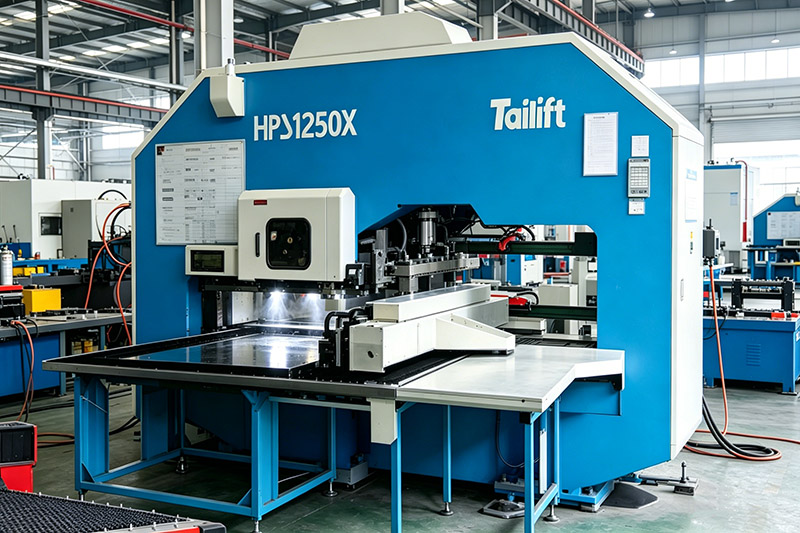
A press forces sheet through or between a punch and die. A single-station die performs one operation per stroke; a progressive die feeds a strip forward one pitch per stroke through stations that pierce, notch, form, coin and blank the part, so a finished part drops off every cycle. Presses run from around a hundred to several hundred strokes a minute. Stamping also forms as it cuts — bends, ribs, lances and in-die tapping can happen in the same pass, removing downstream operations entirely. Our precision stamping service covers which die types suit which volume.
How do the two compare across the five dimensions that decide it?
Five dimensions settle most of these decisions. The ranges below are published industry figures for general sheet metal work, not a promise — confirm them against a live quote.
| Dimension | Laser cutting | Stamping | What it means |
|---|---|---|---|
| Accuracy | ±0.1 mm is an honest production figure on common gauges; heat and sheet movement set the real number. | Typically ±0.05–0.15 mm by thickness and feature; pierced holes near ±0.05 mm, bend angles near ±1°. | Looser than ±0.2 mm? Accuracy is not what decides it. |
| Cost structure | Priced by machine time plus material; unit price is nearly flat from 5 to 5,000 pieces. | Priced by amortising the die; unit price falls as quantity rises. | Cheaper only if the forecast volume arrives. |
| Tooling investment | None beyond programming and nesting. | Simple blanking dies in the low thousands of USD; progressive dies in the tens of thousands, complex tools over USD 100,000. | Tooling is a bet on future volume. |
| Lead time to first part | Days. A revised file re-cuts the same day. | About 4–8 weeks for a simple die, 8–16 weeks or more for a complex progressive die, plus tryout. | A near, fixed launch date decides it. |
| Volume break-even | No tooling to recover, so it wins below the crossover. | Crossovers run from a few hundred pieces for small, quick-cutting parts to tens of thousands for complex dies. | Calculate your own. |
| Design change cost | Zero — edit the file and re-cut. | High: a change after the steel is cut can mean a new station, and changes cascade through the strip layout. | Freeze the drawing first. |
At what volume does stamping become cheaper than laser cutting?
At the volume where the saving per part has added up to the cost of the die. That is the whole calculation, and it is worth running on your own numbers:
Break-even quantity = tooling cost ÷ (laser unit price − stamped unit price)
A small bracket costs USD 2.50 laser cut and USD 0.50 stamped, with the die quoted at USD 8,000 — a saving of USD 2.00 per part, so the die pays back at 4,000 pieces. Now change one input: if the part cuts in ten seconds rather than two minutes, the laser price might fall to USD 0.90, the saving shrinks to USD 0.40, and the crossover moves past 20,000 pieces. Same die, different answer.
Material yield pulls the calculation the same way. A laser nests several part numbers across a sheet but leaves skeleton between them, while a die runs a narrow strip and wastes mostly the carrier — our nesting and material yield guide works through the difference. Both inputs then show up as line items in the quote, which is what our cost breakdown sets out.
| Annual volume | Usually the better route | Why |
|---|---|---|
| Prototype, 1–20 pcs | Laser cutting | Nothing to amortise, and the design is still moving. |
| Pilot run, 100–500 pcs | Laser cutting in most cases | The die rarely pays back; a simple die is worth quoting only if geometry is frozen. |
| Production, 1,000–10,000 pcs | Quote both, compare curves | Where the crossover usually sits for small flat parts. Large, slow-cutting parts stay laser-competitive well past it. |
| 10,000–50,000+ pcs | Stamping | The die is amortised; press speed and very low labour per part take over. |
| High volume, design still changing | Laser cutting — delay the die | A die built on an unfrozen drawing is a sunk cost with a rework bill attached. |
Which process gives better accuracy, edge quality and material range?
Neither is simply more accurate, because they are accurate differently. Laser cutting is adaptable: the machine positions precisely, but the part is influenced by heat input, sheet movement as stress releases, and nest support. Stamping is repeatable: once the die is proven, variation comes from tool wear rather than process drift. So if critical dimensions must hold across a long run of frozen, identical parts, the die gives tighter and cheaper consistency; if parts vary or tolerances are moderate, the laser gets you there faster with no tooling bet.
Material interacts with the process too. Stainless work-hardens and wears die steel, raising tooling cost — one reason stainless stays on the laser longer than its volume suggests. Aluminium galls in a die and needs coatings and lubrication. Mild steel is easiest for both. Thickness sets the envelope: progressive stamping is comfortable to about 6 mm, while laser cutting covers a wider band but loses speed and gains dross risk as thickness rises. Below about 0.5 mm the laser stops being the safe default, because heat can distort the part — which is why shims and vent plates get stamped even at modest volumes. Our material selection guide covers how substrate choice interacts with forming and finishing.
How long does each take, and what does a design change cost?
A laser-cut sample is a scheduling question: the file is nested, the sheet is loaded, and parts are on the bench the same day or next. A stamped first article is a project — strip layout and die design, tool steel and machining, assembly, tryout, sample approval — commonly quoted in the 4–16 week band for the tool itself.
Changes invert the same way. On the laser a change is free and instant, which is exactly why the laser is the standard way to prove out a part that will eventually be stamped. In the die, a change cascades through the strip layout. Our rule: freeze the drawing, validate it with laser-cut samples, then release the die. The tooling investment guide sets out that payback arithmetic.
How do you actually decide — is there a decision tree?
Five questions, in this order:
- Is the geometry frozen? If not, laser cutting — full stop. Never buy tooling against a moving drawing.
- What is the realistic annual volume? Under a few hundred pieces, stop here: laser. A hoped-for forecast counts as low volume.
- Is the part quick to cut or slow? Quick parts cross over late, slow ones early. This is the input most rules of thumb omit.
- Does it need formed features? Ribs, lances, bends or coining built into the die remove entire downstream operations — and a stiffening rib is usually cheaper than a thicker gauge, as our rib design guide explains.
- Run the formula on real quotes and compare the result with your committed volume.
If the first four point at laser cutting but you expect growth, the answer is not to choose — it is to sequence. Cut now, keep the drawing stable, revisit the die once orders are real. For OEM and ODM programs that is the normal path, not the exception; our custom enclosure manufacturing overview covers how we stage it, and prototype to production works through the handover itself.
Frequently Asked Questions
Is laser cutting always cheaper for prototypes?
Yes, and not closely. With no die to amortise, a prototype quantity carries no tooling burden, and the design is by definition still under review — the condition under which a die is the wrong buy. Laser cut the samples, approve them, then release tooling.
Is stamping always more accurate than laser cutting?
No, and it is one of the most expensive myths in sheet metal. Stamping is more repeatable: the die holds one geometry with very little part-to-part variation. It is not automatically more accurate in absolute terms, and it is far less adaptable.
Does the die pay back at around a thousand pieces?
Usually not. Published crossovers span a very wide range depending on part size, cut time, material and die complexity. A thousand pieces only works out when the per-part saving is unusually large and the die unusually cheap.
Can stamping produce features the laser cannot?
Yes, and this is underrated. A progressive die pierces, forms, coins, embosses, lances and can tap in the same pass that blanks the part; on the laser route each is a separate setup.
Do I own the die if I pay for it?
Usually — but state it in the quote. You either pay tooling upfront and own the tool, or the supplier amortises it into the per-part price across a contracted volume. Get ownership and storage terms in writing.
Can I switch from laser cutting to stamping later without redesigning?
Often yes, but not for free. The flat pattern may need adjusting for shearing rather than melting, and hole sizes must suit punch-and-die geometry rather than a kerf. Designing with the eventual process in mind avoids that rework — which is what a DFM review looks for.
Does either process remove the need for deburring?
No. Laser edges carry a heat-affected zone and may carry dross on heavier plate; stamped edges carry a burr set by the die and its wear. Specify the edge condition rather than assuming it — particularly on seams that will be welded.
What should I send to get both routes quoted?
A drawing or model with material, gauge and finish; the annual volume and order pattern; and whether the design is frozen. A supplier can then quote both routes side by side with tooling on a separate line. Tolerance requirements help too — see the tolerance guide.
SanJun's approach
SanJun Hardware runs precision laser cutting as a core step in our fabrication sequence alongside bending, welding, powder coating and assembly, across a 5,000㎡ facility certified to ISO 9001 and ISO 14001 with RoHS and REACH compliance. For most OEM/ODM enclosure and structural-part programs we recommend laser cutting first, then revisit stamping once the drawing is stable and the volume is real. Standard parts ship in 7–15 working days and complex custom builds in 20–30 days; sample lead time is quoted per project, because it scales with how much forming, finishing and assembly the part needs. Each step in that flow is set out in our sheet metal fabrication process guide.
One boundary worth stating plainly: we do not hold CE marking, so if your destination market requires it, raise it at enquiry stage rather than after tooling is committed. Engineers provide free CAD and DFM and quote both routes with tooling broken out.
Not sure whether to laser cut or stamp? Send the drawing with material, gauge and annual quantity — we will return both routes, tooling shown separately, and a recommendation that matches the volume you actually have.
Each of those three consequences is specified rather than assumed; the full breakdown is in our guide to laser cut edge quality, kerf and dross.