Every fire question we have fielded over the past twelve years has arrived in the same shape. A purchasing engineer sends a drawing of a steel box with a note that says "must be flame retardant", and the real question underneath is about something bolted to the steel: a gasket, a gland plate, a polycarbonate window, a cable tie, or the paint itself. Sheet metal enclosure fire rating work is almost never about making the steel better. It is about controlling the small amount of organic material that travels with it. This guide turns the standards into drawing decisions — what an A1 declaration actually means, which tests you will be asked to show, what re-testing a change of colour really costs, and the twelve checks we run before we quote a fire-graded build.
What this guide settles
- Fire rating and fire resistance answer two different questions, and a specification that mixes them cannot be quoted without ambiguity.
- Steel and aluminium do not burn. The fuel load in a metal enclosure is the coating, the seals, the cable entry, the window, the internals and the labels.
- A normal polyester powder coat adds roughly 0.6 MJ/kg of calorific potential to a 1.5 mm steel panel, well under the 2.0 MJ/kg ceiling that A1 allows.
- UL 94, glow wire and needle flame are three different test families measuring three different failure modes. Product standards normally require a combination of them.
- A UL 94 grade is issued per thickness, per colour and per supplier file number. Change any one of the three and the grade does not travel with the part.
- Where the enclosure must hold a fire back rather than simply not feed it, the construction changes completely: double wall, mineral core, intumescent door seams.
Fire rating versus fire resistance: the difference that decides everything
These two phrases are used interchangeably in purchase orders and they describe incompatible things. A sheet metal enclosure fire rating only becomes meaningful once you say which of the two you are asking for, because the evidence, the test house and the price all change with the answer. Getting it straight at the RFQ stage is the single highest-value thing you can do, because a supplier who is asked for "a fire-rated enclosure" without qualification will quote the cheapest interpretation and you will discover the gap at the approval stage.
Fire rating, in the sense most people mean it, is a reaction-to-fire property. It describes how a material or a product behaves when it is the thing on fire. In the European system this is the EN 13501-1 classification, supported by bench tests such as ISO 1182 for non-combustibility, EN ISO 1716 for calorific potential, and EN 13823 for a single burning item. In the North American system the equivalent layer is built from UL 94 for the material and IEC 60695 or UL 746 for the end product. A reaction-to-fire result is a letter and a set of indices: A1, A2-s1,d0, B-s2,d1 and so on.
Fire resistance is a compartmentation property. It describes how long an assembly keeps fire, smoke and heat on one side of a boundary. EN 1363-1 and ASTM E119 govern it, and the output is a time: EI 30, EI 60, EI 90, EI 120. The E is integrity — the assembly does not let flame or hot gas through. The I is insulation — the unexposed face stays below a temperature limit.
An enclosure that is A1 has no fire resistance whatsoever unless it was built and tested as a barrier. An enclosure that is EI 60 will normally also be made of A1 materials, but that is a consequence, not a cause. If your specification says "fire-rated to one hour", you have asked for EI 60, and a fabricator who sends back a UL 94 V-0 material declaration has answered a different question. This is the mistake we see most often, and it is worth one line in the RFQ to prevent it.
One clarification before we go further: IP and NEMA ratings cover ingress, not fire. A NEMA 4X or IP66 rating tells you about dust, water and corrosion. Neither standard tests combustion behaviour. We keep the IP and NEMA comparison separate from this topic for exactly that reason.
What "A1" actually means on a steel enclosure
EN 13501-1 grades A1 and A2 are the non-combustible bands. A1 is the highest: the material contributes almost nothing to a fire. A2 allows a small combustible fraction, and is always qualified by two indices — smoke production (s1, s2, s3) and flaming droplets (d0, d1, d2). A2-s1,d0 is the common European way of declaring a metal panel that carries a thin decorative coating.
Metals are not tested to reach A1; they are listed. Steel, stainless steel, aluminium, copper and zinc are assigned to A1 by the standard's own tables, which is why a bare steel enclosure is not a difficult fire question. The difficulty begins the moment you paint it.
EN ISO 1716 sets the ceiling: A1 requires a gross calorific potential (PCS) of no more than 2.0 MJ/kg. So here is the arithmetic we run with customers who are being pushed into an expensive "fire-retardant coating" they do not need. Take a 1.5 mm cold-rolled steel door. At a density of 7.85 g/cm³, that is 0.15 cm × 7.85 g/cm³, or 11,775 g of steel per square metre. A standard polyester powder coat at 80 µm and roughly 1.5 g/cm³ adds 120 g per square metre per side — about 1.0% of the panel mass per side, or 2.0% coated both sides. Taking a polymer heat of combustion of roughly 30 MJ/kg as an assumption, both coated sides together contribute about 0.6 MJ/kg of panel mass against the 2.0 MJ/kg ceiling.
Two caveats keep that number honest. First, it is an engineering estimate and not a declaration: a formal classification needs test evidence or an assessment from a notified body, and EN 13501-1 has its own rules for how a non-homogeneous product — a thin organic film on a metal substrate — is treated. Second, the estimate only holds for thin coatings. A thick film laminate, a bonded acoustic foam, a plastic liner or a foam-filled cavity can each push a panel well past the ceiling on their own. The coating can be argued about. The foam cannot.
How steel and aluminium behave in a fire
Non-combustible does not mean unaffected, and the difference between the two metals matters more than most specifications admit.
Steel stays solid to roughly 1500 °C and does not melt in any realistic enclosure fire. What it loses is stiffness. On the reduction factors published in EN 1993-1-2, structural steel sheds roughly 40% of its room-temperature yield strength by about 550 °C and close to half by 600 °C. In enclosure terms this means a door that was flat and a latch that engaged cleanly at 20 °C may deflect enough at 500 °C to open a gap at the seal. A fire that never breaches the box can still compromise the gasket line by distorting the box.
Aluminium fails earlier and more completely. A 6061-T6 panel is effectively non-structural by about 350 °C, and melting begins at roughly 585 °C with full liquidus near 660 °C. For a fire-exposed enclosure wall, aluminium is a weight-saving choice, not a fire choice, and the two objectives genuinely conflict. Steel versus aluminium selection is worth revisiting whenever a fire requirement is added to an existing design.
One more number that catches people out: a hot-dip galvanised or zinc-coated panel loses its zinc layer above about 420 °C. The coating oxidises, the corrosion protection goes with it, and the panel that survives the fire reaches the surveyor already compromised. If the enclosure is in a fire-risk location and the finish is galvanised, say so in the drawing so the follow-up inspection covers it.
The fuel inventory of a metal enclosure
If you want to control the fire behaviour of a fabricated enclosure, you have to enumerate what is actually combustible inside and on it. We do this as a written fuel inventory on every fire-relevant quote, because it converts a vague requirement into a bill of materials that can be checked.
| Component | Typical material | Continuous-use temperature | Typical flammability class | Upgrade path |
|---|---|---|---|---|
| Exterior coating | Polyester powder, epoxy powder, wet paint | 90–140 °C | Thin film; substrate governs | Reduce film build; avoid thick laminates |
| Door and panel gasket | EPDM sponge, closed-cell PVC, silicone | EPDM 120–150 °C; silicone 200–230 °C | Depends on compound | Halogen-free silicone, documented compression set |
| Cable entry plates | PA66 nylon glands, nickel-plated brass | Nylon deforms from about 200 °C under load; melts 255–265 °C | Nylon grades vary widely | Nickel-plated brass, stainless, or ceramic |
| Viewing window | Polycarbonate, acrylic, tempered glass | PC 115–130 °C; PMMA 80–90 °C | PC available in V-0; PMMA typically HB | V-0 polycarbonate or tempered glass |
| Internal wiring and ties | PVC, LSZH, nylon ties | PVC 70–105 °C; LSZH 90–125 °C | PVC can be HB | LSZH insulation and metal or ceramic ties |
| Internal insulation and ducting | Foam tape, ABS duct, silicone mat | Varies | Often the weakest item in the box | Mineral-filled or intumescent material |
| Labels and nameplates | Polyester, vinyl, anodised aluminium | Vinyl degrades early | Vinyl typically HB | Polyester or metal nameplates |
| Fasteners and hardware | Zinc-plated steel, stainless | Not a fuel source | Non-combustible | No change needed |
Read that table as a risk ranking, not a specification. The coating is almost never the problem. The items that actually fail end-to-end tests are the gasket compound, the nylon gland, the acrylic window and the PVC wiring — and the reason they fail is usually not that they burn, but that they drip, or that they release smoke and acid gas while they do it.
Smoke density and toxicity are the part of a fire specification that gets forgotten most often, and they decide life-safety approvals in tunnels, stations and enclosed plant rooms. A gasket that self-extinguishes in open air can still fail a smoke chamber test, and a PVC-insulated harness that passes a flame test can still fail an acid-gas assessment. If your project sits in a confined or occupied space, ask for the smoke and toxicity data as well as the flame data. They come from different tests. For sealing geometry that has to survive both heat and pressure, start with the gasket sealing selection guide.
Three test families you will be asked to show
Test requests arrive in clusters, and the three families below cover almost all of them. They are not interchangeable.
Small-flame tests (UL 94, IEC 60695-11-10) put a defined flame on a horizontal or vertical specimen and measure afterflame, afterglow, dripping and burn-through. They are material-level screening tests and the cheapest to run. The classes most often written into enclosure specifications are:
| Class | Specimen orientation | Afterflame per specimen | Dripping that ignites cotton | Typical use in enclosures |
|---|---|---|---|---|
| HB | Horizontal | 30 s applied; burn rate limited | Not assessed | Lowest tier; internal non-critical parts |
| V-2 | Vertical | 30 s or less | Allowed | Internal brackets where dripping is contained |
| V-1 | Vertical | 30 s or less | Not allowed | Internal parts near live conductors |
| V-0 | Vertical | 10 s or less | Not allowed | The default requirement for enclosure internals |
| 5VB | Vertical plaque | 60 s or less | Not allowed | Larger surfaces; no burn-through hole |
| 5VA | Vertical plaque | 60 s or less | Not allowed | Highest tier; no burn-through hole and no plaque perforation |
Glow-wire tests (IEC 60695-2-10 through -2-13) simulate a different failure mode entirely: an overheated connection, an overloaded resistor or a local hot spot inside the box, without an open flame. A nickel-chromium loop is heated to a set temperature and pressed against the specimen at roughly 1 N for 30 seconds. The standard ladder is 550, 650, 750, 850 and 960 °C. Three outputs matter:
| Designation | What it measures | Level | Applied to |
|---|---|---|---|
| GWT (IEC 60695-2-11) | End product: does the finished part ignite and does it self-extinguish | 550–960 °C | The finished enclosure or component |
| GWFI (IEC 60695-2-12) | Material: the highest temperature at which the specimen extinguishes within 30 s without igniting the tissue layer below | 550–960 °C | Raw material, per thickness |
| GWIT (IEC 60695-2-13) | Material: the lowest temperature that causes ignition, reported as a temperature 25 K above the highest passing test | 550–960 °C | Raw material, per thickness |
The ladder value is set by the end-product standard, never by the material datasheet, and this is where a lot of enquiries go wrong. A supplier will happily send a resin datasheet showing GWFI 960 °C when the standard governing the finished product asks for a 750 °C glow-wire pass on the assembly. Expect your product standard to combine the two families rather than accept either one alone — a small-flame class together with a glow-wire temperature is a common pairing, and 750 °C is a value we see written into enclosure specifications repeatedly. Read the standard that governs your product before you buy the material that satisfies it.
Needle-flame tests (IEC 60695-11-5) apply a small 12 mm flame directly to a part for a defined time and check whether the flame spreads or the part is perforated. They are used to simulate a fault inside a small component igniting the material around it, and they are common in component-level approvals rather than whole-enclosure ones.
A word on the electrical side of ignition sources. The glow-wire test is a proxy for a hot joint, and hot joints come from loose terminations and inadequate bonding. That is a mechanical and electrical design problem before it is a materials problem. Grounding and bonding design and clearance and creepage coordination belong in the same conversation as the fire specification, because fixing the source is cheaper than upgrading every material around it.
Why thickness, colour and supplier decide the grade
A UL 94 classification is not a property of a material in the abstract. It is issued for a specimen of a stated thickness, in a stated colour, from a stated supplier file number. All three bind.
Thickness is the most misunderstood. A compound certified V-0 at 3.0 mm frequently falls to V-2, or worse, at 0.8 mm, because there is less material to absorb heat and the specimen can warp away from the flame. If your window retainer is 0.8 mm thick and the datasheet headline says V-0, you do not have a V-0 part.
Colour matters because pigments and colorants change the combustion chemistry. Black and natural grades are usually certified; a custom colour matched to a brand palette may only carry the certification of the base grade, if it carries one at all. Carbon black is a common flame-retardant synergist, which is one reason black grades are often the best performers.
Supplier changes matter because the file number belongs to the compounder. A second-source resin with a similar datasheet is still a different material until it is tested. If your production plan includes a resin or gasket change, plan the requalification into the schedule rather than discovering it during a customer audit.
The practical consequence for a fabricator is a rule we apply in our own quality documentation: fire-critical components are line-itemed with thickness, colour and file number, and tracked as controlled items. If you are buying an enclosure assembly rather than a bare box, ask to see that line-item list in the first-article report. It is the difference between a build that will pass an audit and one that will pass today.
Five application domains and what their specs actually say
The same steel box is asked to satisfy five different requirement frameworks depending on where it is installed, so a sheet metal enclosure fire rating is never one specification but five. This table is the fastest way to find yours.
| Domain | Governing requirement | What your drawing must state | Notes |
|---|---|---|---|
| Industrial machinery | IEC 60204-1, UL 508A, IEC 61439 | Internal material classes, glow-wire value, wiring insulation | Assembly certification is separate from material certification |
| Rail rolling stock | EN 45545-2 (requirement sets by location, HL1–HL3) | Applicable requirement set, hazard level, smoke and toxicity limits | Limits flame spread, smoke density and toxicity together |
| Building-installed | EN 13501-1 Euroclass, local building code | Euroclass with s and d indices, or EI rating if compartmentation | Façade rules may apply to roof-mounted plant |
| Battery energy storage | UL 9540, UL 9540A, NFPA 855, IEC 62933 | Propagation strategy, barrier construction, venting, separation distances | Enclosure behaviour is assessed at unit and installation level |
| Outdoor and telecom | IEC 62208, UL 50E, Telcordia GR-487, IK rating | Material, UV and corrosion exposure, impact class, security | Environmental and impact ratings run in parallel with fire |
For industrial machinery, the fire requirement arrives through two doors. The material classes in the table above apply to the components inside, and the assembly itself is covered by UL 508A and IEC 61439 assembly certification. These are different certificates held by different parties, and a machinery buyer needs both — the component declarations from the material suppliers and the assembly declaration from the panel builder. Where the machinery sits in a classified atmosphere, the ignition-risk assessment replaces the material-class conversation entirely and hazardous-location builds for ATEX and IECEx zones take over.
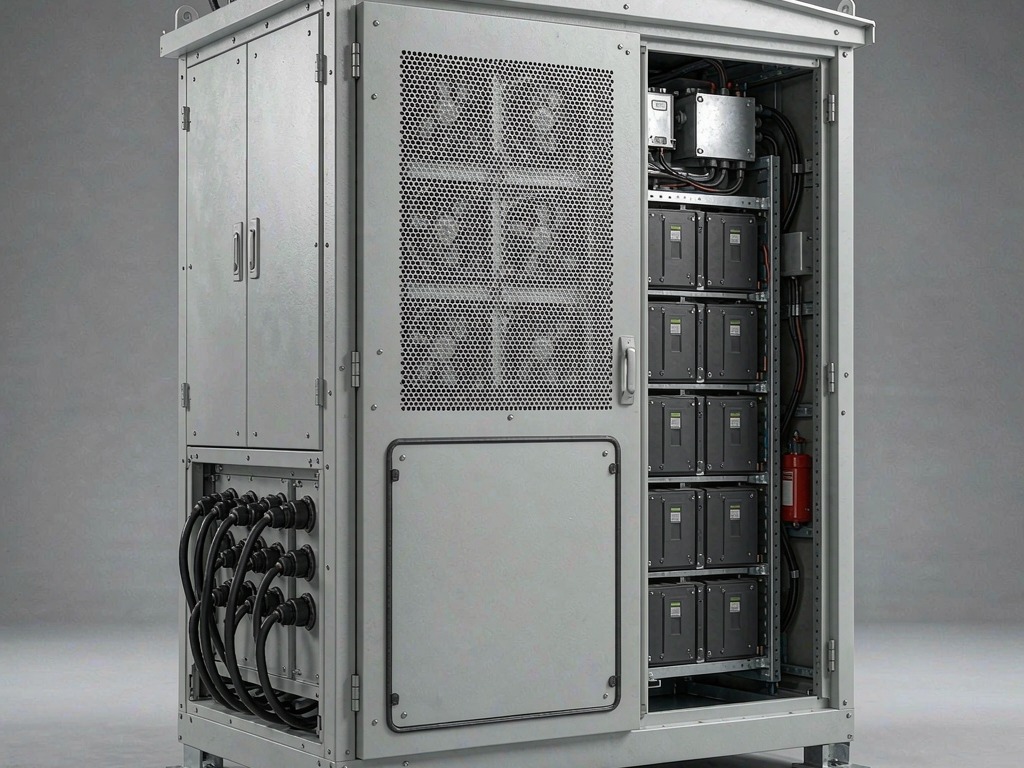
For energy storage, the framework is about propagation rather than material burning. UL 9540A is a test method that establishes whether thermal runaway in one cell or module propagates to its neighbours; UL 9540 certifies the system; NFPA 855 sets installation rules including separation and, in some cases, deflagration venting. A steel enclosure is a natural barrier material here, but the enclosure is only one element of a strategy that also includes cell chemistry, spacing, detection and suppression. Venting design is where fire and enclosure thermal management meet, and the ventilation openings that solve a thermal problem can become the path that carries flame to the next module. If your project is a storage cabinet, energy storage cabinet enclosures covers the mechanical side; keep this article open alongside it.
When the enclosure has to be a barrier, not just a cover
There is a step change in cost when the requirement moves from "does not contribute to a fire" to "holds a fire back for a stated time". A single-skin steel box, however well built, is not a barrier. Achieving EI 30 or EI 60 requires a construction, not a material.
| Build-up | Typical period | Construction notes |
|---|---|---|
| Single skin, powder coated | None | Reaction-to-fire only. No integrity or insulation |
| Single skin plus intumescent door seam | Partial, unverified | Seam seals close gaps under heat; does not insulate |
| Double wall, mineral wool core | EI 30–EI 60 | Wall thickness 40–60 mm typical; core density and fixings decide the result |
| Double wall, mineral core, ceramic door gasket | EI 60–EI 90 | Gasket must survive the full period; hardware stays outside the hot face |
| Dedicated fire-rated cabinet interface | EI 90–EI 120 | Purpose-built; penetrations are the design driver, not the panels |
Four rules apply to all of them. First, penetrations fail before panels do; a cable entry that is not sealed to the same standard as the wall is where the fire gets through, and that is why gland plate design and intumescent collars belong in the same drawing. Second, door retention matters more than door stiffness; a door that stays closed under thermal bowing carries the seal, and that is a hinge and latch hardware decision as much as a panel decision. Third, a continuous welded seam is a better barrier than a bolted or riveted one, which is why barrier cabinets are usually of welded construction — welding process control is part of the fire specification here, not a separate topic. Fourth, insulation attracts condensation, so a barrier cabinet in a humid room needs condensation control inside sealed enclosures designed in from the start rather than retrofitted as a heater.
Deflagration venting is the one case where the enclosure is deliberately designed to open. Where a battery cabinet or a dust-handling enclosure can accumulate a flammable atmosphere, the vent is a safety device and its area, location and release pressure come from a hazard analysis. A vent designed as a fire feature and a vent designed as a thermal feature are rarely the same opening, and the two must not be reconciled by guesswork.
Three build logs: what a fire requirement changes on the drawing
These are three jobs from our own quote and build log over the past twelve years, written with the numbers attached. Each one is a case where the stated requirement and the actual objective turned out to be different things.
Build log 1 — a Nordic fast-charging operator and a coating that was not needed
A charging network operator in northern Europe issued a tender for roadside charger enclosures with a requirement that read "exterior surfaces shall use a flame-retardant coating". Their consulting engineer had carried the requirement over from an indoor electrical room specification. The quoted premium for a specialised intumescent-additive powder was around 40% on the finishing line item, and it came with a lead-time penalty because the coating was not held in stock.
We asked for the underlying objective. It turned out to be a national requirement to document the combustible content of publicly installed street furniture. That is a material-declaration question, not a coating-performance question. We supplied the coating's calorific potential data, the film weight, and the arithmetic above showing the coated panel at roughly 0.6 MJ/kg — comfortably inside the A1 ceiling. The specification was amended to a standard polyester powder at 80 µm with a declared PCS. The premium came off the quote, the lead time returned to normal, and the documentation requirement was met with data rather than with a more expensive finish. The lesson was not that flame-retardant coatings are worthless. It was that nobody had asked what the requirement was for. If your project has a similar clause, find the objective first — and if you need the comparison between finish systems, powder coating versus liquid painting covers where each one earns its cost.
Build log 2 — a Texas storage integrator and a gland that melted first
An integrator building containerised battery storage for a Texas site ran a unit-level fire test on a module enclosure and failed it in a way they had not predicted. The steel box survived intact. What failed was the cable entry: the nylon glands softened and deformed at around 220 °C, opening a path through the gland plate, and the flame front found it.
The fix had three parts, and only one of them was a material swap. First, the glands were replaced with nickel-plated brass with silicone seals, which moved the softening point out of the range that mattered. Second, an intumescent strip was added around the gland plate perimeter so that the plate-to-wall joint closed as it heated, rather than opening as the gasket relaxed. Third, the internal harness was re-routed so that the cables no longer ran directly above the module terminals — a change that cost nothing and removed the most direct ignition path. The re-test passed, and the change added roughly 6% to the enclosure hardware cost.
The general rule this illustrates: in a fire test, the lowest-melting component sets the result. Catalogue the melting or softening point of every non-metallic item on the assembly and rank them. The one at the bottom of the list is the one your test will find.
Build log 3 — an EU rail signalling enclosure and a gasket that smoked
A signalling supplier working to EN 45545-2 for a trackside enclosure had a door gasket specified as closed-cell foam on the basis of its flame behaviour alone. The material self-extinguished cleanly in a small-flame test. It failed the project's smoke density requirement, because closed-cell foam compounds can produce dense smoke long before they produce flame, and in a tunnel or an enclosed station that is the hazard that matters.
The replacement was a halogen-free silicone sponge with a documented compression set, specified by the same geometry so no tooling change was needed, and with smoke and toxicity data supplied to the same requirement set. Unit cost rose by a few euros per door. What made the fix cheap was that the sealing groove had been designed with enough depth tolerance to accept a different compressibility, which is a DFM decision made months earlier.
Two lessons came out of that job. First, EN 45545-2 sets flame spread, smoke density and toxicity limits together under a requirement set chosen by the part's location and function, at hazard level HL1, HL2 or HL3 — so ask which set applies before you choose a material. Second, design the sealing groove to tolerate a range of gasket materials, because the gasket is the component most likely to change after a fire test.
Twelve-point DFM checklist for fire-graded enclosures
This is the block we use internally and the one customers forward to their own design teams. Each line is written the way it should appear on a drawing or in a purchase order.
- State the property, not the adjective. Write "reaction-to-fire class A2-s1,d0 per EN 13501-1" or "enclosure material V-1 or better with 750 °C glow-wire pass per the applicable product standard". Delete the phrase "flame retardant" on its own.
- Separate rating from resistance. If you need EI 30 or above, say so in its own clause with the test standard and the period. Do not bundle it with the material class.
- Declare the substrate and the gauge. Steel at 1.2 mm, 1.5 mm or 2.0 mm changes both the fire behaviour and the structural behaviour. Ambiguity here propagates into every other decision.
- Declare the coating system, film build and colour. Specify the nominal film thickness and the PCS data if the project has a combustible-content requirement. Thick laminates and bonded foams need their own declaration.
- Line-item the non-metallic components with material, thickness, colour and supplier file number. Gaskets, glands, windows, ties, ducts and labels all appear on this list.
- Give the gasket both a flame and a smoke requirement where the installation is occupied or confined. A material that passes one can fail the other.
- Check the window material separately. Polycarbonate can be supplied in a V-0 grade; acrylic usually cannot. If a viewing window is required, decide the material before the retainer geometry is fixed.
- Specify metal or ceramic cable retention inside the box wherever the operating temperature of a fault exceeds roughly 150 °C. Nylon ties and nylon glands are the most common early failures.
- Seal every penetration to the same class as the wall. Gland plates, vents, filters and door seams are the paths a fire actually uses. A barrier is only as good as its weakest opening.
- Keep hardware outside the hot face on any barrier construction. Latches that sit on the exposed side lose their temper and their adjustment.
- Define the evidence format before the order is placed. State whether you need material datasheets, third-party test reports, a declaration of conformity, or a full assembly test — and who pays for it.
- Record the change triggers. Write down which changes force a re-test: thickness, colour, supplier of a fire-critical part, gasket compound, window material, or a move to a different production site. This single line prevents most audit failures.
What to write in the RFQ
Copy this block, fill in the brackets, and you will get comparable quotes instead of a range of guesses. Every line exists because a missing entry on that line has cost a customer a re-test at some point.
- Application and location: [e.g. roadside EV charger, unstaffed, urban]
- Governing standard and requirement set: [e.g. UL 508A / EN 45545-2 requirement set / EN 13501-1]
- Reaction-to-fire requirement: [Euroclass with s and d indices, or UL 94 class with thickness]
- Glow-wire requirement: [temperature and which test, if applicable]
- Fire resistance requirement: [EI period and orientation, or "none"]
- Substrate and gauge: [material, thickness, finish]
- Non-metallic component list: [supplier to propose, with file numbers]
- Smoke and toxicity requirement: [limits, or "not applicable"]
- Evidence required at delivery: [datasheets / test reports / declaration / none]
- Change-control statement: [which changes require notification and re-test]
Ask for the response in the same order. A supplier who answers the fire-resistance line with a material class has not read the enquiry, and that is useful information before you place an order rather than after.
Frequently Asked Questions
Is a steel or stainless steel enclosure automatically fire rated?
A sheet metal enclosure fire rating is a claim about a product, not a property of a material, and that distinction gives the answer. The substrate is non-combustible and is normally declared A1 or A2-s1,d0, so in the material sense yes. But "fire rated" as a product claim needs a defined basis — a class, a standard and an evidence format. An unpainted steel box is A1 by virtue of its material; the finished assembly with a gasket, a window, a gland plate and a wiring harness is a product, and its behaviour has to be established on the product's terms.
What is the difference between UL 94 and EN 13501-1?
They answer related but different questions. UL 94 is a material-level small-flame test that produces classes such as V-0 and 5VA for a specific thickness and colour. EN 13501-1 is a construction-product classification that produces a Euroclass such as A1 or A2-s1,d0 for a defined product. A UL 94 V-0 material is not automatically a Euroclass B product, and a Euroclass A1 panel is not automatically a UL 94 5VA material, because the specimens and the exposure conditions differ.
Do I need a glow-wire test if I already have a UL 94 grade?
Usually yes, if the end-product standard asks for it, because they simulate different failure modes. UL 94 answers "does this material sustain a flame?" A glow-wire test answers "does a hot spot that is not a flame ignite this material?" Panels and cabinets in mains-powered equipment are commonly required to satisfy both. Always work from the end-product standard, and check the current edition with your test house or your AHJ.
Can a powder-coated steel enclosure still be A1?
In practice, yes for common film builds. A 1.5 mm steel panel with a standard 80 µm polyester powder coat lands around 0.6 MJ/kg of calorific potential against a 2.0 MJ/kg ceiling for A1. The estimate changes with film build and coating chemistry, and a declared classification requires test evidence or a notified-body assessment. Thick decorative laminates, bonded acoustic foam and plastic liners are much more likely to be the deciding factor than the paint.
What changes force a re-test of an existing approval?
Treat thickness, colour and supplier of any fire-critical part as controlled parameters. A resin or gasket that passes at 3.0 mm in black may not pass at 0.8 mm in a custom colour, and a second-source compound is a different material until it has been tested under the same file. Changes to the window material, the cable entry hardware or the production site can also invalidate an assembly test. Write the triggers into the purchase order so they are managed rather than discovered.
Does an IP66 enclosure have any fire rating?
No. IP codes describe protection against solid objects and water; they say nothing about combustion. A sealed enclosure may however change the fire behaviour in a way that matters, because smoke and heat that cannot escape through the shell will find the cable entries and the door seam instead. Fire performance and ingress protection are separate specifications that have to be designed together.
Add one more line to that RFQ: the substance declarations must be ordered when the material is bought, and how RoHS and REACH declarations have to be ordered at material-purchase time explains which documents simply cannot be produced at delivery.
Next step
Send us the applicable standard, the installation location and the internal heat load, and we will return a fire-compliance pack: a fuel inventory for your design, the component classes we would specify with file numbers, the barrier build-up if an EI period applies, a marked-up drawing showing the twelve DFM points that need attention, and a fixed-price quotation. Enclosures, cable entry and mounting hardware come from one facility, so the fire-critical details are decided at the same table as the bend radii. Request a fire-compliance review and you will have the pack within 24 hours.